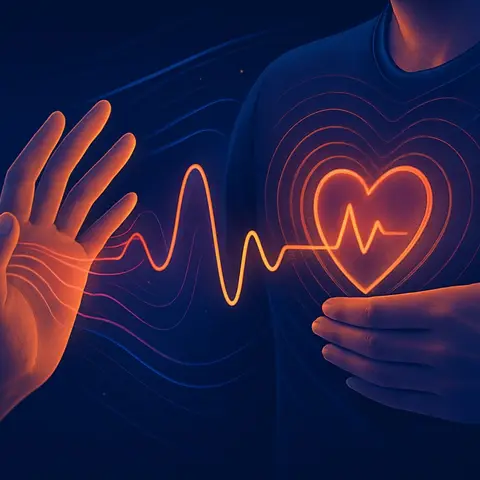
Heartbeat Resonance: Inducing Non-contact Heartbeat Sensations in the Chest
Perceiving and altering the sensation of internal physiological states, such as heartbeats, is key for biofeedback and interoception. Yet, wearable devices used for this purpose can feel intrusive and typically fail to deliver stimuli aligned with the heart’s location in the chest. To address this, we introduce Heartbeat Resonance, which uses low-frequency sound waves to create non-contact haptic sensations in the chest cavity, mimicking heartbeats. We conduct two experiments to evaluate the system’s effectiveness. The first experiment shows that the system created realistic heartbeat sensations in the chest, with 78.05 Hz being the most effective frequency. In the second experiment, we evaluate the effects of entrainment by simulating faster and slower heart rates. Participants perceived the intended changes and reported high confidence in their perceptions for +15% and -30% heart rates. This system offers a non-intrusive solution for biofeedback while creating new possibilities for immersive VR environments.
Waseem Hassan, Liyue Da, Sonia Elizondo, and Kasper Hornbæk. 2025. Heartbeat Resonance: Inducing Non-contact Heartbeat Sensations in the Chest. In Proceedings of the 2025 CHI Conference on Human Factors in Computing Systems (CHI '25). Association for Computing Machinery, New York, NY, USA, Article 913, 1–22. https://doi.org/10.1145/3706598.3713959
Transcript 2,282 words
Welcome to the deep dive. You know that desire to get up to speed on a complex topic quickly, but also thoroughly. Today we're tackling something fundamental, connecting with our own bodies, specifically those internal sensations. Think about feeling your heartbeat, maybe enhanced by technology. Could tech truly deepen this very personal connection? Well, this deep dive explores heartbeat resonance. It's a novel system that, get this, induces non-contact heartbeat sensations
directly within your chest cavity. Our guide today is some cutting-edge research, a paper from CHI 25 by Waseem Hassan and colleagues. They're based at the University of Copenhagen and Universidad Publica de Navarra. So our mission for you is to unpack how this technology functions, look at what the experiments demonstrated, and explore its considerable potential for biofeedback and maybe immersive digital experiences. We want to pull out the core insights. Let's start with the context.
There's this growing need, wouldn't you say, in modern life to understand and engage with our internal physiological states. Disruptions there can noticeably impair cognitive performance, general health. That's right. And we've long used biofeedback for this. It's essentially using physiological data to help people regulate functions, usually outside conscious control. Okay. Which is different from entrainment. Entrainment is more passive. External stimuli sort of guide or sync up with physiological
rhythms. You aren't consciously trying to change things. Right. And traditional methods, often wearables, they've had limitations, haven't they? They can be intrusive, maybe a bit cumbersome. And the feedback often comes to, say, your wrist, which isn't where you naturally sense your heart. Exactly. That spatial mismatch is a problem. Plus, comfort, restriction of movement, delivering feedback that feels internal and natural without contact. That's been a major challenge. Which brings us neatly to heartbeat resonance.
It's positioned as a solution to these very problems. It uses low frequency sound waves, apparently, to create these non-contact haptic sensations, mimicking heartbeats. How does that work technologically? It's based on acoustics. When you can find low frequency sounds in a sealed space, you get standing waves. Think of them as fixed patterns of high and low sound pressure in the air. Uh-huh. These specific pressure fields can actually induce tactile sensations on the body.
So the system harnesses this. It designs digital heartbeat signals and uses these low frequencies to modulate them, effectively creating a heartbeat feeling inside the chest cavity. No wires, no direct contact. Fascinating. And they built a special room for this, made of MDF, medium-density fiberboard, with specific dimensions. Yes, quite precisely built. 1.7 by 2.18 by 2.12 meters. The room is key to controlling the acoustics and ensuring those standing waves form properly. And a powerful subwoofer, too,
an SVS-SB4000. That's needed to generate those low frequencies accurately. Right. And with enough power to create perceivable sensations, up to 300 hertz. But it's the very low end that's crucial here. So how do they know where in the room the sensation will be felt? That involves some physics and computation. They use the Helmholtz equation and finite element analysis, FEA. These tools let them predict the sound pressure
distribution within the room, mapping out where the pressure maximal will occur. This allows them to target the sensation, specifically at chest height for a seated participant. And they found specific frequencies were important. They did. They identified 14 modal frequencies below 200 hertz. And one in particular, 78.05 hertz, emerged as quite significant for inducing these sensations effectively. So with the setup ready, the first step was validation. Did people actually feel these non-contact heartbeats? How real did
they feel? This first experiment was about evaluating perceived realism, intensity, location on the body, and the type of sensation. They compared it against a real heartbeat sound baseline. Correct. The team crafted digital heartbeat signals very carefully. They replicated the main components, the lub sound, S1, and the dub sound, S2. They even added a subtle tail after the dub for more realism. These are based on a
150 hertz sine wave shaped with an envelope. They tested a basic version, lub-dub, and an enhanced one with the tail. And these signals were then modulated using four of those low frequencies identified earlier. 78.05 hertz, 100.09 hertz, 156.1 hertz, and 200.18 hertz. And who participated? 14 individuals, eight females, six males, age between 24 and 29. So what were the key findings from this first test?
What worked best? Well, for perceived realism, that 78.05 hertz modulation frequency consistently scored highest. This was true for both the basic and enhanced digital signals. Higher than the others? Significantly so. And interestingly, lower frequencies generally felt more realistic, creating that sense of an internal sensation. The 78 hertz signal was even rated as significantly more realistic than the actual recorded heartbeat signal played through the system. Hold on, the generated signal felt more real than a real
recording. That's what the data showed. It implies that the way the sensation is delivered internally via these pressure waves might be more crucial for realism than the acoustic fidelity of the source sound itself when delivered externally. That's a profound point. What about intensity? Intensity showed a different pattern. The highest frequency, 200 hertz, produced the most intense sensations. There seemed to be an inverse relationship
generally. Lower frequencies for realism, higher frequencies for intensity. But you said 78 hertz was significant. Yes. 78 hertz was the exception. It managed to score highly on both realism and intensity. Kind of a sweet spot. Okay. And where did people feel it? Was it localized to the chest? Overwhelmingly, yes. The heat maps generated from participant feedback showed sensations consistently localized to the central torso, the chest area, across almost all conditions. Lower frequencies tended to produce
slightly more localized sensations too. And the type of sensation, inside or on the surface? Participants most often described it as feeling inside the body, especially with that 78 hertz modulation. Fewer felt it just on the skin surface. How did that compare to the real heartbeat recording? The real recording was more often perceived as a surface sensation, again highlighting the unique effect of
the heartbeat resonance delivery method. So, based on all this, the enhanced heartbeat signal modulated at 78.05 hertz was selected for the next phase. It offered the best combination of perceived realism and that crucial internal sensation quality. Right. Which leads to experiment two. This one focused on perceived entrainment, that subjective feeling of your own heart aligning with the external signal, not necessarily actual physiological synchronization,
but the perception of it. Correct. They used that optimal signal. Enhanced heartbeat, 78.05 hertz modulation. Then they varied its rate relative to each participant's resting baseline heart rate. How much variation? They tested plus 15% faster, plus 30% faster, negative 15% slower, and negative 30% slower. And they compared delivery methods. Yes. They compared heartbeat resonance delivering the sensation to the chest against traditional vibro-tactile feedback, a small motor vibrating on the participant's right wrist. Who participated in
this one? 20 participants this time, an even split of 10 female and 10 male, age 20 to 28. What did this experiment reveal about perceiving heart rate changes? Participants were generally able to perceive the direction of the change. For heartbeat resonance, 65% reported feeling an increase when the plus 15% signal was presented, and 50% reported feeling a decrease with the nihil 30% signal. How did that
compare to the wrist vibration? The vibro-tactile condition showed more varied results, especially when participants were asked about perceiving a decrease in heart rate. It seemed less consistent. And what about their confidence in these perceptions? While there wasn't a statistically significant difference across all conditions, there was a pattern. Participants tended to report higher confidence when using heartbeat resonance, particularly for perceiving the plus 15% increase and the 90% decrease. Suggests a
clearer signal, perhaps. But wasn't there also a finding about actual physiological heart rate? Yes, and this is quite noteworthy. In the condition using heartbeat resonance at plus 15% BPM, there was a statistically significant change in the participants' actual measured heart rates compared to their resting baseline. So it wasn't just perception in that case, it actually influenced their physiology. In that specific condition, yes. It points towards actual physiological entrainment occurring, even with relatively
short exposure. So summing up experiment two, heartbeat resonance demonstrated effectiveness in inducing perceived entrainment, and in one key condition, measurable physiological entrainment as well. That feels like a significant step. Let's zoom out then. Why is this non-contact in-chest approach potentially so important? What are the broader implications? From a theoretical standpoint, a few mechanisms likely play a role. The baroreceptor reflex is a strong candidate. That's the body's rapid system for regulating blood pressure, sensitive to
changes in heart rate perception. The vagal afferent pathways, nerves carrying sensory info from organs to the brain, might also be stimulated by these chest sensations. Other theories, like operant conditioning or resonance frequency feedback, usually require longer exposure times than used here. And how does it stack up against current methods, like the wearables we discussed? Well, the clear advantages are comfort, and the naturalness of the sensation delivering it to the chest aligns better with our innate body map.
The major limitation currently is the need for that controlled acoustic environment. You can't just walk around with it like a watch. True. However, in the direct comparison study, heartbeat resonance performed on par with, and sometimes better than, vibro-tactile feedback. It seems to provide a more consistent experience and foster higher confidence in perceiving the signals. What's the core benefit then of feeling it in the chest? Inducing the sensation there seems to foster entrainment more readily and perhaps more
importantly, has the potential to enhance interoceptive ability. That's our capacity to sense our own internal bodily states. It could help the brain build a more accurate internal model, which might be especially helpful for people with lower interoceptive sensitivity. Think of it like the rubber hand illusion. The more realistic the fake hand feels, the stronger the illusion. Here, the realism seems to enhance the connection to the internal state.
Makes sense. And just to recap the optimal parameters. Yes. The enhanced heartbeat signal, modulated at 78 hertz, seems best for realistic sensations and entrainment. For inducing a perception of excitement or higher arousal, the plus 15% BPM increase was effective. For promoting a perception of calm, the negative 30% BPM decrease showed the most promise. Okay, so with this refined understanding, what kinds of
practical applications could we envision? The potential is quite broad. Obvious ones are in biofeedback offering a comfortable, perhaps more effective alternative to wearables for stress reduction or focus training. In virtual reality, it could add a powerful layer of realism and emotional depth. Imagine feeling your heart race in a tense simulation or calm down in a meditative VR environment. That would be immersive. Definitely. Another application is object state conveyance. Using heartbeat patterns may be
faster or slower, stronger or weaker to communicate the status of devices. Is your battery low? Is a component about to fail? The heartbeat could convey that intuitively. Like a vital sign for objects. Exactly. And then there's the application you noted earlier, fostering empathy. Imagine a system allowing you to feel the heartbeat of another person in real time. This could be used in
therapy, collaborative work, or social VR to build connection and understanding. That last one has some profound social implications. But as always, there are limitations to the current research. What did the researchers highlight? The main ones were the controlled environment. A single empty sealed room isn't the real world. And the exposure times in the experiments were quite short, generally not long enough to induce widespread physiological changes, apart from that one plus 15%
condition. So what's next for this line of research? They plan to explore longer exposure durations, maybe three to five minutes, to see if that leads to more robust physiological effects. Longitudinal studies are also needed to assess long-term benefits, especially for things like emotional regulation or improving interoceptive awareness over time. And specifically investigating if this can measurably improve interoceptive accuracy, helping people become better at actually
detecting and interpreting their internal signals. So as we wrap up this deep dive, here's a thought to consider. What happens when technology can subtly influence our perception of our own internal states? Could this reshape our self-awareness, our connection with others? It seems we might be moving beyond just displaying information towards creating a deeper felt experience of physiology our own, and perhaps even that of others. We encourage you to think about that. The potential for non-contact physiological feedback to
weave itself into future technology, from therapy to social platforms, what might the implications be? It's certainly something to ponder.
Going into teaching language is definitely something to ponder. Right. At least something to ponder. At least something to ponder. At least something to ponder. At least something to ponder. At least something to ponder. At least something to ponder. At least something to ponder. At least something to ponder. At least something to ponder. At least something to ponder. At least something to ponder.
At least something to ponder. At least something to ponder. address what can't understand what our Music can play intwithaction with item ahead that their expression for text down how can't stop play However can they view your skill will often det forms out there we don't Moines who don't believe it So by phone call through hope so interest does things out