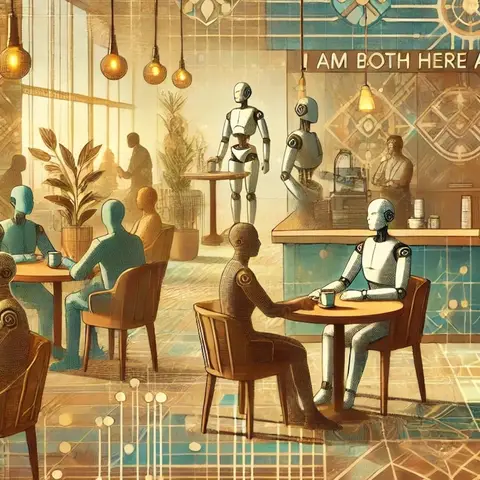
“I am both here and there” Parallel Control of Multiple Robotic Avatars by Disabled Workers in a Café
Robotic avatars can help disabled people extend their reach in interacting with the world. Technological advances make it possible for individuals to embody multiple avatars simultaneously. However, existing studies have been limited to laboratory conditions and did not involve disabled participants. In this paper, we present a real-world implementation of a parallel control system allowing disabled workers in a café to embody multiple robotic avatars at the same time to carry out different tasks. Our data corpus comprises semi-structured interviews with workers, customer surveys, and videos of café operations. Results indicate that the system increases workers’ agency, enabling them to better manage customer journeys. Parallel embodiment and transitions between avatars create multiple interaction loops where the links between disabled workers and customers remain consistent, but the intermediary avatar changes. Based on our observations, we theorize that disabled individuals possess specific competencies that increase their ability to manage multiple avatar bodies.
Transcript 1,173 words
Ever imagine being in, like, multiple places at once? I'm not talking, like, teleportation or anything. This is about parallel embodiment. And we're diving straight into it. A Tokyo cafe where this is actually happening. It's called the Avatar Robot Cafe Don Verbaro. It's a real place where robots serve you. But here's the thing. People with disabilities, we call them pilots, control these robots remotely.
Okay, hold on. So, real robots, real customers, a real cafe. This isn't just, like, a research project. Nope, totally real. And it's been around for a bit, building on years of research. You can actually buy these robots. They're called Orihimes. Wow. Okay, so two sizes, right? They're the smaller ones you see on tables and then the bigger Orihime Ds that can actually, like, move around.
Exactly. Gotcha. So, I walk into this cafe. I'm talking to an Orihime. But somewhere else, someone is controlling it. What's that even like for the customer? So, that's where it gets really interesting. Originally, each pilot could only control one Orihime. But the researchers realized that was kind of limiting, don't you think? Like, imagine only being able to interact with a couple customers because you're stuck in one spot.
Yeah, I can see how that would be frustrating. So, how do you even go from controlling one to, like, multiple avatars? This actually came from the pilots themselves. They wanted more control, you know, more freedom to really interact with the customers. So, that's how they started developing this whole parallel control system. That's so cool. This big tech leap was driven by, like, wanting a more human experience.
So, how'd they even design that? Well, they worked directly with six pilots over four months. They had to develop an interface that worked for everyone.
Imagine that. You've got eye gaze technology, touchscreens, keyboards. It had to be adaptable. Yeah, that sounds crazy complex. Okay, so let's say I walk into this cafe wanting a coffee. What's going to happen? All right, so you walk in and an Oriheim greets you. That's your first interaction with the pilot. Then, that same pilot uses another Oriheim to take you to your table.
Hold on, I haven't even ordered yet, and this is all one pilot. We're just getting started. You get to your table, and another Oriheim, still the same pilot, takes your order, maybe chats with you while you wait. And, get this, a fourth Oriheim, the Oriheim D. That one brings your drinks over. And, it's the same pilot who greeted you at the door.
Whoa, that is a lot for one person to handle. What about the pilots? How do they keep up with all that? It's, um, it's definitely a lot to handle. One pilot, he actually compared it to, like, being an airplane pilot. Makes sense with all that multitasking. Yeah, like, constantly switching between screens, voices, different tasks. He even mentioned this one pilot, right? He was chatting with someone at one table while moving the Oriheim D with the drinks, and totally missed another customer walking by.
Oh, wow. I guess that's the downside of all that multitasking. So, how'd they, like, adapt to that? Well, a lot of it was their previous experience. You see, many of them already used assistive technology. Oh, okay. So, things like spatial awareness, multitasking, they were already good at that. So, think about it if you're navigating, say, a physical space virtually, or even using a communication device with limited mobility.
That actually helps with this kind of parallel control. Right, right. So, not starting from scratch. It's almost like a whole new skill set is developing. Totally. And it makes you rethink what work can even look like, you know? Yeah, absolutely. It shows that accessibility isn't just about removing barriers. It's about creating entirely new possibilities. That's a really good point. Okay, so we've talked about the pilots, but what about the customers?
How'd they react to being served by, you know, multiple robots controlled by the same person? So, besides the whole robot thing being pretty cool, customers actually felt like they got better service. Because remember, it's the same pilot throughout your whole visit. Yeah, yeah. That consistency, that feeling of having, like, a dedicated host, people really like that. Interesting. You'd think robots would feel impersonal, but this actually makes them feel more personal.
Yeah. It's like having your own personal staff member. One customer even said it felt like a luxury shop. Wow. But, I don't know, I can also see how it could be a little strange, right, seeing the same robot in different places. Oh, yeah, for sure. Some customers, they were kind of confused. Imagine you're talking to a robot, and that same robot walks by, serving drinks to someone else.
That is pretty wild. Did the pilots, like, ever play with that? All the time. They got really creative. Sometimes they would project their voices through two robots at once. No way. So, customers thought the robots were talking to each other. Exactly. They were using the technology in ways no one expected. And get this, customers could even recognize specific pilots just from how they controlled the robots.
Wait, really? Just from their movements? Yeah. Even though the robots all looked the same, the pilots, they had their own, like, style. Customers even compared it to recognizing someone's walk from a distance. That's crazy. It shows that you don't need a super realistic robot for a real connection. Just a bit of personality and some creativity can make all the difference. This whole thing just, I don't know, it makes you think about the future of work, doesn't it?
Yeah, definitely. And not just, you know, cafes in Tokyo, but, like, the whole picture. Right. Like, it's cool and all, but what's the takeaway here? Well, it makes you rethink work for people with disabilities, right? Yeah. What if your physical limitations didn't matter? What if you could work from anywhere, be anyone or anything? Oh, yeah. Like, we always talk about telepresence, but this is next level.
Exactly. But there's this human element we can't forget. Right, right. It's not just about the tech. It's about empowering people, taking their skills, their personalities, and letting them, you know, really shine through. Totally. So it's about making work more inclusive, more flexible. I mean, even more human, even if, you know, robots are involved. Exactly. And this study, it just shows what we can do if we rethink our ideas about work, about ability, about connecting with each other.
It's like, what if tech didn't just make life easier, but, like, way more interesting. Yeah, that's a future I want to be a part of. Yeah. Well, on that note, I think it's time to let all this sink in. Thanks for joining us for this deep dive. We'll see you next time for, you know, more explorations into the future.
Thank you.