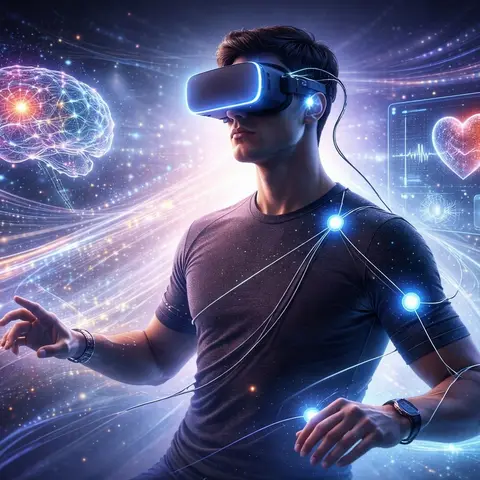
Cognitive Load: Cognitive Load Inference Using Physiological Markers in Virtual Reality
How hard is your brain working in VR? This paper presents a machine learning system that predicts cognitive load in real time using behavioral and physiological signals collected through VR headsets. Trained on data from 738 participants across various VR experiences, the model achieves remarkably low error (MAE of 0.11) in predicting mental workload. The system analyzes markers like eye movements, head motion, and physiological responses to infer how cognitively demanding a VR experience is for users. This has significant implications for adaptive VR systems that could automatically adjust difficulty, pacing, or complexity based on the user's mental state. The researchers also release a test dataset from 100 participants to enable further research in this area.
Jishang Wei, Erika Siegel, Prahalathan Sundaramoorthy, Antônio Gomes, Shibo Zhang, Mithra Vankipuram, Kevin Smathers, Sarthak Ghosh, Hiroshi Horii, Jeremy Bailenson, and Rafael Ballagas. 2025. Cognitive Load Inference Using Physiological Markers in Virtual Reality. In 2025 IEEE Conference Virtual Reality and 3D User Interfaces (VR), Saint Malo, France. IEEE. https://doi.org/10.1109/VR59515.2025.00098
Transcript 2,244 words
Welcome to the Deep Dive. We're here to transform your stack of sources on a complex topic into critical knowledge you can use immediately. Today, our mission is focused on a major breakthrough at the nexus of virtual reality and human cognition. You've brought us a substantial study, a massive effort with 738 participants that seems to have cracked a central paradox in adaptive training. And that paradox is all about cognitive load.
Mm-hmm. CL. Right. The total mental effort it takes to process information. VR is known for this profound immersion, which is great for learning. In theory, yes. But that same immersion can push the brain into overload, which of course impairs the user's ability to retain anything. Learning just stalls if the demand is too high. And that is precisely the wall these researchers managed to demolish. Their breakthrough was developing a machine learning solution that
can predict this mental effort, this cognitive load, in real time. In real time. And critically, they engineered it to work without needing any initial calibration for a specific user. That is a game changer for deploying VR training at scale. That capability is immense. Before we get into the tech, let's set the foundation. Where does this whole concept of load come from? Why is it such a bottleneck?
Well, people have been studying how hard we think for a little over a century. But the guiding framework here is cognitive load theory. Okay. The theory outlines that any successful task completion depends on this constant complex balancing act. It's between sensory inputs, our long-term memory, and the crucial system for immediate processing, working memory. If you're trying to learn something new, it must pass through this working
memory. And the research highlights three non-negotiable facts about its capacity. First, it's fixed. It doesn't change. For your entire life. Correct. Second, it's limited. It has a small capacity, so you can only hold a few pieces of information at once. And third, it varies a great deal from one person to the next. So we all have this small, fixed-sized container, but the size of that container
is different for each of us. Precisely. And if that container overflows, if the sensory input is just too much, the consequence isn't a slowdown. The learning just stops. It's a hard limit. It is a hard limit. The challenge the researchers were tackling was how to get around that limit dynamically. The goal is to build sophisticated, adaptive VR training tools. Systems that use an AI-driven
inference engine to monitor a person's mental state continuously. The comparison to existing tools is quite telling. Most systems estimate cognitive workload post-hoc, so after the fact. Or they require extensive calibration tasks to set a baseline. Which defeats the purpose of seamless, real-time training. To get this flexible, calibration-free solution to work across a diverse population, the study had to be enormous. It certainly did. 738 participants. They were recruited from communities across four continents
with an age range from 19 to 61. That's a massive sample for a VR experiment. It is. And when you're building a generalized, person-independent model, that diversity is paramount. They sought maximal variance to minimize sampling bias. So the model isn't just trained on, say, 20-year-old college students. Exactly. They intentionally included participants across the educational spectrum, from elementary school all the way up to graduate degrees, plus broad variance in age, race,
and ethnicity. This robustness was vital for accounting for those individual differences in processing capacity we just discussed. Let's turn to the experiment itself. To train an AI to predict load, you first have to objectively define what low, medium, and high load even are. How did they do that? They built a virtual environment in Unity 3D, and they designed tasks to induce three distinct levels
of cognitive load. Each level was repeated three times, randomized, for nine trials per person. And the design here has a certain elegance to it. It's additive. They weren't just presenting three totally different scenarios. No, they were building a sort of cognitive obstacle course by stacking demands on top of each other. So what was the first level, the low CL condition? The foundation was a visual
vigilance task. Participants had to track one highlighted ball moving among five others, and then report its final position. A simple visual tracking task. Okay, straightforward. And for medium CL? For medium, they introduced parallel processing. Participants did that exact same visual vigilance task, but simultaneously with an arithmetic task. Mental math problems would appear and disappear quickly. Forcing them to divide their attention. It forces a division of resources within that limited working memory.
And then, high CL must have been the triple burden. It was. It involved performing, the visual tracking, the mental math, and a third layer. An audio vigilance task. They had to listen for a beep, and when they heard it, report the spinning direction of another visual element. I can feel my own brain starting to strain just hearing that. You're forcing engagement of visual spatial tracking, arithmetic,
and auditory monitoring all at once. That provides a very clear objective definition of difficulty. It does. And on top of that, at the end of each trial, participants gave a subjective measure. They rated the mental demand they felt on a scale from very low to very high, which was adapted from the NASA task load index. So that self-report, the feeling of difficulty, became one half of the ground truth for the model.
Essential half, yes. So we have the objective task and the subjective rating. Now for the core of it, how did they capture the physiological signals that would correlate with these effort levels in real time? They used a sophisticated suite of sensors. Some were integrated into a modified HTC Vive Pro-i headset, and they also used an external sensor for PPG pulse plethysmography from the finger.
And what were the key signals they were looking for? They focused on two categories, both well-established indicators of mental effort. The first was pupilometry and eye tracking. The eyes? Yes. Pupil dilation, specifically, is highly sensitive to changes in cognitive load, and it's relatively independent of what the user is actually looking at. They track features like mean pupil diameter, blink rate, and the statistics of saccades, those rapid eye movements.
It's somewhat remarkable that something as simple as pupil size or how your eye twitches can betray how hard you're thinking. It's a powerful proxy. The second category was PPG, which is essentially heart activity. It estimates cardiac activity by measuring these tiny changes in blood flow. And what metrics did they pull from that? They analyzed things like the interbeat interval and various pulse rate variability metrics.
These measure the small critical inconsistencies in heart rhythm that signal activation of the sympathetic nervous system, a key indicator of stress or high mental demand. But the source material notes a serious problem with PPG. Movement creates noise. In a dynamic VR setting, how reliable can that heart data actually be? That's a warranted skepticism, and the researchers knew it was a major hurdle. To ensure reliability,
they developed a complex six-step processing algorithm. It focused heavily on filtering out movement noise and refining peak detection using signal quality indexes. So a rigorous data cleaning process. It was essential to extract clean cardiac features for a generalized calibration-free model. Okay, so they have the clean physiological data. The next big challenge is establishing the ground truth. If cognitive load has a subjective component, how do you give the model a single
verifiable label for the true CL score? This is where their approach was quite ingenious. They created a final score, a continuous value from zero to one, using a multi-pronged labeling approach. They blended the label. Blended? How so? They combined two factors. First, the normalized subjective rating from the individual. What the person felt. And second, the normalized objective task difficulty. What the task was known to demand from the general population. So they blended the person's self-reported
exhaustion with the known difficulty of the exam, to use an analogy. A task known to be hard gets a higher score, even if one specific participant found it easy. Exactly. This blended approach is crucial because it implicitly captures the full distribution of cognitive load, spanning both objective demands and individual subjective experiences. By training on that mixed distribution, the model learns to generalize much better to real-world scenarios.
So let's talk about the model itself. What kind of architecture did they use to fuse the data streams from the eyes and the heart? They develop a dual-branch attention deep learning model. The dual-branch design lets the model analyze the eye tracking data and the cardiac data in parallel. And the attention mechanism. That's the crucial part. It allows the model to intelligently fuse or combine the information from both signals at a high level.
This multimodal fusion is a proven strategy. It enhances both robustness and prediction accuracy. And what were the quantifiable results? The model predicts cognitive load as a value between 0 and 1. How accurate was it? The performance was remarkable. The multimodal fusion model achieved a mean absolute error, or MAE, of 0.11. Can you contextualize that for us? An MAE of 0.11? Of course. If you imagine a difficulty scale from 0 to 100, that MAE means the model is, on average, only off by about 11 points across that entire scale.
That level of precision is sufficient for an AI to make critical adjustments to a training environment. Did the model have any trouble distinguishing between the different difficulty levels, say between medium and high load? It did. That's a subtle but important nuance. The model had a valuable secondary capability. It could predict the objective task difficulty levels with about 79% accuracy. However, the researchers noted that it frequently confused the medium and high difficulty levels.
Which suggests that for many people, the medium task might have already pushed them past their saturation point. Precisely. Once they're overloaded, adding a third task doesn't register as a greater physiological burden because the brain is already maxed out. They were likely at subjective cognitive saturation. Furthermore, the study also quantified the prediction uncertainty itself, which is vital for any real-world deployment. The model doesn't just give a score. It estimates a probabilistic distribution.
It gives you the mean cognitive load and its associated variance. Why is that variance so important to know? Trustworthiness. It lets the system, or a human operator, gauge the confidence of each prediction. If the model says a user is overloaded with a score of 0.8, but the uncertainty is high, the system might hesitate. If the score is 0.8 and the uncertainty is low, it can react immediately.
And the practical deployment of this academic work is quite clear. It has successfully transitioned into the commercial sphere. It has. This research led directly to the HP Reverb G2 Omnicept Edition commercial VR headset, with this exact inference engine built in. Meaning this capability is available off the shelf for enterprise training. And its use is expanding rapidly. For instance, Ovation VR uses the engine for adaptive learning in public speaking training.
PISO leverages it for real-time feedback and high-stakes VR training for construction and public safety. Even academic researchers are using it to study things like virtual commerce. All of which leads back to the core purpose. Linking this real-time prediction to performance optimization. What's the guiding principle for these adaptive adjustments? It's the Yerkes-Dodson curve, also known as the inverted U-curve. It maps the relationship between performance and arousal, or load.
If we can dynamically measure CL, we can target that ideal performance state. And avoid the extremes. We must avoid the two extremes. Excessive workload leads to cognitive overload and errors. But minimal load leads to disengagement and reduced focus. So the system's job is to constantly guide the user toward that sweet spot. That optimal state is often called the Goldilocks zone. It's where cognitive load is perfectly balanced.
Not too hard. Not too easy to maximize challenge and engagement for peak performance. Detecting CL dynamically allows designers to modulate the task to keep the user in that zone. To summarize this deep dive, then, you've shared sources on a pioneering large-scale study. It succeeded in reliably translating physiological signals from the eyes and heart into a quantifiable, real-time measure of mental effort in VR.
And it achieved this without requiring that time-consuming individual calibration. That's what makes it viable for global application. As we look to the future, the researchers identified a central limitation that will define the next phase of this work. The persistence of significant individual variability in physiological responses. Even with a study this large, building a truly universal person-independent model remains a challenge. Which brings us to a powerful final thought.
It raises a key question for developers. If a person-independent model is this effective, imagine the precision we could achieve if models were fine-tuned to an individual's age, gender, educational background, or other personal traits. But that level of hyper-personalization would require vastly more personal data. It would. And the challenge moving forward will be navigating that trade-off between the increased customization afforded by deeper data and the inherent privacy considerations that come with widespread VR applications.