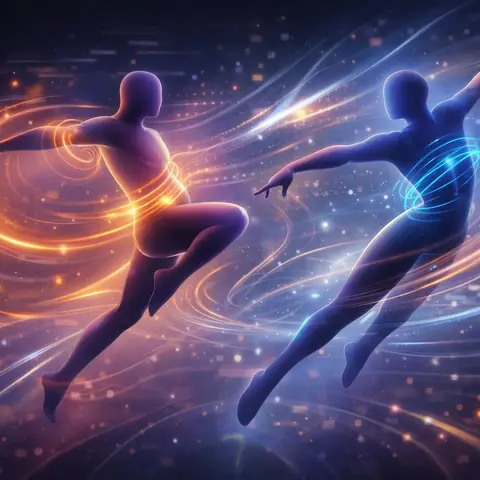
Haptic Dance: Automatic Generation of Haptic Motion Effects Expressing Human Dance
Watching a dance performance engages your eyes and ears—but what if you could also feel the dancer's movements? This paper presents algorithms that automatically convert motion capture data from human dance into haptic feedback, letting viewers physically experience the performer's movements through vibrotactile devices. The approach cleverly separates external movements (the dancer traveling through space) from internal movements (limb gestures and body rotations), processing each optimally for haptic rendering. Internal movements are decomposed into segments to maximize clarity and expressiveness, then all components are merged with appropriate scaling and weights. The result is a system that can take any dance motion capture and automatically generate compelling haptic effects—no manual authoring required. This opens new possibilities for immersive dance experiences in VR and beyond.
Jaehyeok Ahn and Seungmoon Choi. 2025. Automatic Generation of Haptic Motion Effects Expressing Human Dance. In 2025 IEEE Conference Virtual Reality and 3D User Interfaces (VR), Saint Malo, France. IEEE. https://doi.org/10.1109/VR59515.2025.00058
Transcript 2,520 words
Welcome back to the Deep Dive, where we convert specialized source material into essential knowledge tailor-made just for you. Today, we are diving into a corner of extended reality that is, well, quite captivating. We're looking at how to automatically generate haptic motion effects. Effects that are designed to let you feel a dancer's performance. To physically perceive it. Precisely. This is a deep dive into multisensory engineering.
We're exploring an algorithm that tackles this immense computational hurdle. The hurdle of converting fluid human movement into physical stimuli. Motion effects, yes. The kind that engage your vestibular system. Right. If you've ever been in a 4D theater or used advanced XR equipment, you know how crucial that precise motion feedback is. And the fundamental challenge here, at the heart of the source material, is one of massive information compression.
It is. Think about the complexity of human dance. Every joint, every muscle action, it's an incredibly high number of degrees of freedom. Dozens, even. A human skeleton possesses dozens of degrees of freedom, or DOFF. But the motion platforms we use for simulation, the chairs, the hydraulic seats, they are physically constrained. They operate using a maximum of 6 degrees of freedom. The standard 6-to-off system.
That's the one. So let's just quickly break that down. 6 degrees of freedom means you have three rotational axes. Correct. You have roll, which is tilting side to side. Pitch for tilting forward and back, and yaw for turning left and right. And then the other three. The translational axis. That would be surge, moving forward and back, sway for side to side, and heave for up and down.
And taking the expansive language of dance and forcing it into those six mechanical commands is where the true engineering challenge resides. The core claim from the researchers is that generic motion effect algorithms, they just fail when you apply them to something as expressive as dance. They do. So by creating a novel specialization of these object-based motion effects, they promise a significantly enhanced multisensory experience.
One that allows you to not just watch the movement, but to truly perceive it physically. That's the goal. Okay, let's unpack this methodology. It all starts with deconstructing human movement for simulation. And the first, perhaps most critical decision, was splitting the dancers' movements into two components. External and internal. They found that processing everything as one block just created noise. Noise? How so?
Well, the external movements, that is the overall movement of the entire body in world space, sliding or spinning across the floor, they tend to mask the subtle details of the internal actions. I can see why. If a dancer is leaping horizontally, that massive surge displacement would just drown out the, say, the tiny rotation of their wrist in a simple algorithm. Exactly. The external movement is the dancer's global position.
To track this, the kossi kicks, the tailbone joint, is chosen as the base link. It serves as a neutral anchor point. A neutral point for calculating the transformation of the entire body across the stage. So if the kossi kicks moves, the whole chair translates. That's the external movement. What about the internal side of things? Internal movements refer to the rotations of the body links relative to that kossiak space.
This is mainly the head and the limbs. These internal actions are the language of the dance. They convey the dancers' intent, emotion, and style. So you have to process them independently. You do. It's essential to convey both the large movements and the subtle flourishes at the same time. This extraction method then requires some serious data distillation. We're talking about converting immense raw data from motion capture into concise variables for the platform.
And they do this using what the paper calls motion proxies. These proxies are data condensation engines. That's a good way to put it. For the external movement, they merge the body's overall translation and rotation into the translation of a single point in world space. This creates the external motion proxy. And that proxy maps directly to the platform surge, sway, and heave. The chair's positioning movements, yes.
Okay, but for the internal movements, the decomposition gets even finer. They found that viewing the body as one single articulated mass was just insufficient for dance. Correct. They segmented the body into four key components. Torso, arms, legs, and shoulders. This decomposition represents a kind of optimal trade-off. A trade-off between clarity and expressiveness. Yes. Too few segments and you lose the detail of the limb movement.
Too many. And you start introducing unwanted noise that degrades clarity. And these four internal proxies, they incorporate rotational variables, roll, pitch, and yaw, and they're weighted by the visible size of the body part. That's right. The concept is that visually significant movements should contribute more to the final effect. A large arm sweep contributes more than a subtle finger twitch, for instance. It ensures the output reflects what the human eye naturally focuses on.
It does. Which sets the stage for the second section. Specialized processing for choreography. We have the data separated and segmented. Now we need to clean it up and, crucially, customize it for dance. The first technical step is obtaining velocity terms through numerical differentiation. This process is necessary, but it notoriously amplifies noise. Which is why they implement wavelet denoising to clean the signal.
And following that denoising, there's a key difference in how the data is treated. High-pass filtering is applied only to the internal movements. Only internal. Why the strict distinction? Wouldn't filtering smooth out the motion generally? It's a sensible point, but the issue is a physical one. Saturation. Low-frequency components in the input variables can push the motion platform to its physical limits, its workspace boundaries, and just lock it there.
Making it ineffective. Completely. Now, external movements, which represent overall body travel, are usually slow enough that their low-frequency energy is small. It avoids saturation. But the internal movements, the arms, legs, torso rotations, they contain a lot of low-frequency sway, subtle shifts that could cause the motion chair to drift or hit its stops if they weren't filtered. Precisely. They filter the internal components to keep the platform responsive and centered.
This ensures the rotation effects feel immediate and distinct, not just a gradual tilt into a hydraulic limit. Now, here is the step that makes this algorithm truly specific to choreography, non-linear scaling. It is the key. In most generic motion applications, a slow movement signals preparation, or an unimportant lull. But in dance... In dance, a slow movement can convey the deepest emotional meaning.
Or intent... Intent, yes. If you treat velocity linearly, those subtle, slow movements get obscure. They get dropped below the platform's detection threshold. To prevent this, they apply a power function. Using an exponent, which they call alpha, how does that power function help? Well, if the exponent is less than one, the function scales the motion so that smaller velocities are emphasized far more prominently than larger, faster ones.
Ah, so it gives a boost to the tiny, controlled movement. A significant boost. A gradual extension of a leg in ballet, for instance. The output ensures the viewer physically perceives that slow, deliberate action that's so critical to the art form. That addresses the subtlety. Now, the four internal segment proxies, torso, arms, legs, shoulders, they have to be combined into a single internal motion proxy for the platform's rotational commands.
And this merging process is customized based on human perceptual studies of dance. The roll and pitch motions of the merged proxy are calculated as weighted sums of the torso, arms, and legs segments. But the yaw motion, the left-right turning, is handled differently. The paper states it's determined solely by the shoulders segment. That seems, well, it seems to be sacrificing some data. What's the justification?
It's a profound design decision, and it's rooted in audience perception. Research confirms that when watching a dancer, audiences overwhelmingly focus on the dancer's upper body and gaze. The shoulders and torso, mainly. Especially for cues on turning direction and emotional intent. By dictating the platform's yaw rotation using only the shoulder segment, the algorithm ensures the motion effect aligns perfectly with what the viewer's attention is focused on.
Which would make the physical effect feel completely intuitive. And natural to the perceived movement. Before the final commands, there is one last adjustment. Variance-dependent rescaling. This sounds like it restores the magnitude of the signal, but also accounts for differences between dance genres. That's it, exactly. It's a heuristic rule addressing the vast range of movement speeds. Think of the minimal sustained variations in ballet compared to the rapid expansive movements in hip-hop.
So the mechanism uses standard deviation to penalize proxies with large fluctuations. It does. So if a dance form like hip-hop has fast, high-variance movement, its proxy is scaled down slightly to accommodate that speed. Conversely, for a form-like ballet with its small variations, the signal is scaled up. Preserving the subtlety that the non-linear scaling already emphasized. Precisely. It prevents the chair from becoming overwhelmed by fast-paced movement while still allowing for detailed expression of slow movements.
And after all this complex processing, the signal finally becomes a physical command. That conversion happens through model predictive control, or MPC. Think of MPC as the ultimate platform translator and safety check. It solves an optimization problem subject to the physical limitations of the platform itself. It's maximum acceleration, speed, and positional limits. All of it. This prevents the chair from trying to execute an impossible or dangerous or just an excessively jarring maneuver.
And this is where the external and internal processing paths finally converge. The external proxy generates the platform's translation commands. Surge, sway, and heave, yes. While the internal motion proxy generates the platform's rotation commands roll, pitch, and yaw. This mapping utilizes the full 6-Duelf capability. It translates the dancer's journey across the floor through translation and the expressive articulation of their body through rotation.
Which brings us to Section 3, Perceptual Validation and Competitive Results. They didn't just build this. They tested it rigorously with human perception. The first study focused entirely on how they merged those internal proxies. They compared three weighting policies. There was Uniform, or UNI, where all segments contributed equally. Salient, SEL, which boosted the contribution of faster or more energetic segments. And their proposed method, Selective, or SEL.
Yes, which prioritizes the most active segment, with a specific bias toward upper body movements for yaw. And what did users report about feeling the dance? SEL and SAL were rated significantly higher than UNI in harmony, meaning the effect matched the perceived movement better, and also in detail. Participants felt these methods provided superior expressiveness. Especially for detailed limb actions. It was particularly noticeable for genres with very fast movements, such as the kicks and arm swings in the Charleston.
So detail and harmony improved when they weighted the movements perceptually. But there is often a trade-off when you maximize detail. There was. UNI, despite being less expressive, was preferred for comfort. It yielded lower fatigue scores. Participants sometimes found the highly detailed motion from SL and SEL to be excessive. Distracting, even. It demonstrates attention inherent in multisensory design. Maximizing fidelity can sometimes compromise comfort.
But the high scores for causality, the feeling that the chair's motion was genuinely caused by the dancer, that was high across all three conditions. So their foundational choice, especially the shoulder-based yaw, was perceptually sound. It was. The second user study was the ultimate proving ground, comparing the fully specialized SEL method against previous general algorithms. They compared SEL against MAB multiple articulated bodies and PME, pixel motion estimation.
And it's important to note, MA and PME were adapted from simpler 3DF systems. They inherently didn't utilize the full capability of the chair, unlike SEL's full six-dove approach. The results seemed quite definitive. They were. SEL achieved substantially higher scores across all measures. Harmony, causality, detail, and overall preference. The source provides concrete evidence where the specialization proved its worth. Okay, let's take a high-energy dance form, hip-hop or Charleston.
Where did SEL succeed there? For those genres, which pair dynamic limb actions with large horizontal displacements, the separation of external and internal movements was pivotal. MAB and PME, which generally treat all link motions identically, they failed to capture the detail. Their motion effects were just simple chair movements. Reflecting only the overall horizontal translation and missing the flare of the arms and legs.
And for slower genres, such as ballet, where that non-linear scaling was so essential. Ballet involves many subtle, slow, internal movements. Since MA and PME use merged link movements and lack that specialized scaling, they completely obscured these nuances. SEL captured them effectively. Participants reported enhanced immersion, that feeling they were truly experiencing the slow, controlled power of the dancer. The final test must have been in sequences that contained opposing forces.
That's correct. In the choreography known as NIDI, the dancer's upper and lower body often move in opposite directions simultaneously. The single proxy methods, MA and PME, suffered from a catastrophic cancellation effect. The forces neutralized each other. And the result was abnormally weak or sudden jagged effects that broke the immersion. SEL's multi-proxy merging system prevented this cancellation, yielding significantly higher scores in causality and fatigue for that specific genre.
The system knew when to prioritize, even when movements conflicted. So, to summarize this deep dive, the dedicated features, the independent processing of external and internal movements, the specialized segmental decomposition, and that non-linear scaling tailored for choreography, result in an experience that is demonstrably superior. It is. The central takeaway is that for complex artistic data, general-purpose solutions simply do not suffice. Specialization is the route to a superior user experience.
But the researchers do acknowledge current limitations. They do. The algorithm relies on high-quality 3D motion capture data. This means it isn't yet applicable to general 2D videos you might find online. And of course, dance is a full sensory event. It's inherently coupled with music, with rhythm, and emotional context. Integrating those components into the algorithm is certainly the next frontier. Without a doubt.
But reflecting on the success of this method, for translating the complexity and intent of human choreography, we are left with a provocative thought for you to consider. If these principles, the separation of external and internal movement, the use of segmental proxies, and specialized scaling, proved so effective for dance, how might they revolutionize multi-sensory experiences in other analogous applications? Applications where the communication of subtle human dexterity is paramount.
Such as in advanced surgical training simulations, or perhaps high-fidelity robot operation interfaces. That suggests that the language of dance might be teaching us a better way to communicate human skill across vast technological barriers. We encourage you to continue the discussion on your own. Thank you for joining us for this deep dive. Thank you.
Thank you. Thank you. Thank you. Thank you.