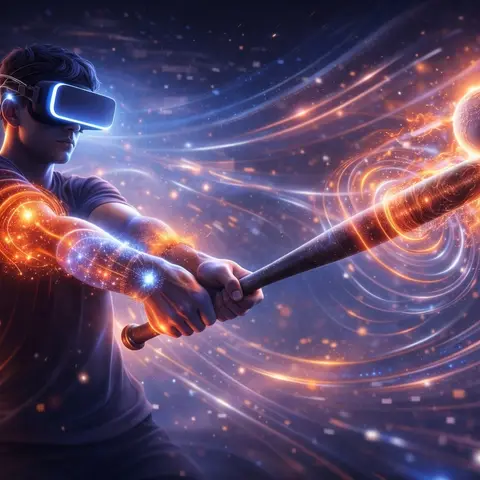
Tingling Aftereffects: Presenting Tingling Aftereffects Using Vibro-Thermal Feedback to Enhance Impact Sensation in Virtual Reality
When you hit a baseball hard, you don't just feel the moment of impact—there's a lingering tingle that follows. This paper explores how to recreate that aftereffect in VR to make impacts feel more realistic. The researchers built a VR baseball bat that delivers not just the initial hit, but also vibrotactile and thermal feedback that simulates the tingling sensation after a strong swing. In a study with 24 participants, both vibration and temperature changes as aftereffects significantly enhanced how realistic the impact felt, with high-frequency vibrotactile stimuli being particularly effective. This work shows that realism in haptic VR isn't just about the moment of contact—the sensations that linger afterward matter just as much for creating convincing physical experiences.
Hikaru Fujita, Juro Hosoi, Yuki Ban, and Shin'ichi Warisawa. 2025. Presenting Tingling Aftereffects Using Vibro-Thermal Feedback to Enhance Impact Sensation in Virtual Reality. In 2025 IEEE Conference Virtual Reality and 3D User Interfaces (VR), Saint Malo, France. IEEE. https://doi.org/10.1109/VR59515.2025.00074
Transcript 2,762 words
Have you ever landed a perfect hit in a virtual game only to feel a, well, a disappointing little buzz? It just pulls you right out of the experience. It does. Today we are diving into the science of feeling. Specifically, how engineers are trying to solve that exact frustration in virtual reality. How do you make a strong physical impact feel visceral and authentic?
And crucially, how do you do it without building dangerously powerful equipment? Exactly. The technical challenge is significant, and our deep dive today focuses on some groundbreaking research that moves past just replicating the force of that initial collision. Instead, the focus is placed entirely on the often overlooked physiological after effects. The sensations you experience after a strong physical strike. Think of that jarring sting that travels up your arm when you hit a hard ball just slightly off-center.
That internal sting, that lingering sensation is the key this research unlocks. We know haptic feedback is fundamental to achieving high-level VR immersion. Yet, when designers try to replicate a high-intensity impact, say a powerful punch or a hard hit, they run into immediate obstacles. What kind of obstacles are we talking about? Well, traditional methods, whether using complex electrical muscle stimulation or attempting to miniaturize high-force hardware, are just severely constrained.
You have safety requirements, device complexity, and the sheer cost of creating a durable, powerful actuator small enough for consumer use. So it's an engineering bottleneck. It is. And this new approach solves that dilemma by proposing a conceptual shift. The core concept, which is well-detailed in the source material, is to decompose the total impact sensation into two specific manageable components. Okay. The momentary immediate collision itself and then the subsequent lingering after effects.
So you separate the two. You do. And by prioritizing and meticulously simulating these secondary internal sensations, the researchers found they could overcome the physical limitations of reproducing that initial high-intensity force. And they could do it without compromising user safety or practicality. It's actually a perceptual hack. I appreciate that framing. A perceptual hack. It changes the engineering goal from build stronger to simulate smarter.
Precisely. Let's unpack this novel concept then. You mentioned focusing on the after effects. What is the specific internal sensation they sought to reproduce? And why did they select that one? They focused on that very common tingling sensation that follows a forceful strike. Okay. The tingling. Yes. And physiologically, this sensation is quite complex. It encompasses elements of numbness and also a specific thermal sensation, which can manifest as a burning or searing feeling.
Their hypothesis then was what? That simulating this after effect would be enough. Their hypothesis was straightforward. If you can accurately present these internal secondary sensations that naturally emerge after a strong impact, you can dramatically enhance the perceived realism and overall intensity of that impact for the user. And this would work even if the initial physical force delivered by the VR device, the collision part, was quite weak.
That was the crucial part of the hypothesis. And this marks a fascinating departure from the standard haptics playbook. Well, previous tactile methods focused almost entirely on that first fraction of a second. They used components like solenoid actuators for a quick impulsive force or high frequency voice coil actuators to simulate immediate vibration. Right. The initial thump. The initial thump. Right. What's more, some earlier studies that did use electrical stimulation actually expended effort trying to mask or reduce these unwanted tingling sensations.
They saw them as artifacts of the stimulation. So they saw it as a bug, not a feature. Exactly. In contrast, this new methodology identifies that tingling sensation not as an artifact to be minimized, but as a critical piece of perceptual information to be deliberately and strategically leveraged. They're weaponizing a controlled tingling after effect to serve as an enhancer. They are. They're fooling the brain into registering a more severe impact than the hardware actually delivered.
So to test this, the researchers needed a realistic simulation platform. Tell us about the hardware they engineered for this study. What was this baseball bat-like device actually capable of delivering? The device they created was a dedicated VR controller designed to simulate holding a bat handle. Okay. It was about 190 millimeters long, weighed 357 grams, and was constructed using 3D printing. So it was highly reproducible and easy for participants to grip.
And its genius lay in the components, I assume. It did. It integrated three primary feedback components, each dedicated to presenting a sensation in the correct temporal sequence. So the hardware effectively had two stages of delivery. That's a good way to put it. For the initial collision feedback, the mechanism that gives you the immediate thud, they utilized a solenoid actuator for that sharp impulsive force.
Uh-huh. And that was paired with a voice coil actuator, essentially a small, highly precise vibration motor, to deliver the high-frequency vibrations that mimic the sound and feel of the bat vibrating on contact. And then came stage two, the after effects. The second stage, yes. The after effects feedback. This was designed to simulate that deep internal tingling and heat. And this is where the more sophisticated components came in.
They used a second voice coil actuator specifically tuned for vibrotactile stimulation. This was intended to induce the sensation of numbness. Numbness, right. And for the heat. For the heat or burning pain element, they incorporated a solid state component called a Peltier device, along with a thermistor and a heat sink. And that provides a rapid, localized thermal sensation on the palm. A very rapid and very controlled one.
Let's pause there for a moment. Why select vibrotactile and thermal feedback as the chosen modalities for this after effect? Why not try to replicate that internal sensation in a different way? The rationale was rooted in practicality and repeatability. These modalities, vibration and heat, were chosen specifically because their actuators are readily available, highly suitable for repeated, controlled use, and relatively easy to adjust in terms of intensity and duration.
Which wouldn't be the case with, say, chemical methods. No, it stands in stark contrast to the complexities you'd face with chemical methods, which might involve substances like capsaicin or the inherent safety and control challenges posed by high-intensity electrical methods. They needed a system they could reliably manipulate in a laboratory setting. Makes sense. And what about the specific parameters? How much vibration? How much heat?
In terms of the specifics, they systematically tested the effectiveness of the vibrotactile after effect using two distinct settings. A low frequency of 50 Hz and a significantly higher frequency of 500 Hz. Why those two? Well, preliminary tests suggested that the higher frequency was considerably more effective in achieving that targeted numbness sensation. I see. And the thermal feedback. For that, they utilized a temperature increase of 3 degrees Celsius above the participants' natural palm temperature.
They were seeking a noticeable controlled thermal increase without causing any actual discomfort. Okay, let's delve into the neurological timing, which is, frankly, the most inventive aspect of this entire investigation. The body is a clock, and the researchers knew that to make this perceptual hack believable, they couldn't just blast the after effect immediately. They needed to engineer a critical delay. A delay that replicated the natural timing within the human nervous system.
Tell us about that. Precisely. This timing strategy relies on fundamental differences in how our nervous system transmits signals. When you experience real numbness and heat from a strong impact, that signal is detected by specialized polymodal receptors. Okay. And then it's transmitted to your brain via what are called slow C fibers. Slow C fibers. Think of these fibers as the nervous system's old postal delivery system.
They transmit signals at a sluggish speed, sometimes as slow as half a meter per second. Wow, that is slow. It is. And this results in a perception delay of about one second before that internal sensation fully registers in your conscious awareness. So there's a built-in lag. There's a natural biological lag. Now, compare that to the sensation they are presenting, the vibrotactile numbness.
This sensation is detected by mechanoreceptors. And those signals travel along the fast A-alpha and A-beta fibers. And I take it these are not the postal service. These are the nervous system's fiberoptic cables. They transmit signals at speeds of 50 to 100 meters per second. They are nearly instantaneous. Okay, so I see the problem. If the engineers delivered that fast vibration immediately upon collision...
The user would feel the numbness before their brain naturally expected it. And the whole illusion would be shattered. He would feel completely artificial and out of sync. That's a clever problem to solve. So they realized they had to make the fast feedback wait for the slow natural perception window. How did this timing mismatch lead to two separate strategies for the vibrotactile and thermal components?
Well, the core of this strategy was managing that transmission speed differential. For the vibrotactile numbness, the presented signal is fast, but the natural sensation is slow. Therefore, they had to introduce a precise program delay of approximately one second from the moment of collision. To match the arrival time. To ensure the arrival time of the fast fiber feedback matched the natural perception time of the real slow fiber sensation.
They also carefully incorporated a fade-in and fade-out effect to make the transition feel more organic. Very subtle. And the thermal component, was it the same? The thermal heat component, however, was handled differently. The pathways for both the real heat sensation and the presented thermal feedback align. Both are transmitted by those slow C fibers. Ah, so they're both using the postal service. Both are slow.
Since the signal speed is inherently slow for both, the thermal feedback was initiated simultaneously with the collision. Because the lag is already built in, biologically. The lag is built in. The synchronization resulted in a naturally matching perception time for the heat sensation. So it required no engineered delay. It's a stunning example of exploiting biomechanics to enhance technology. That distinction between the timing of touch and vibration versus internal pain and heat is the structural linchpin of the entire study.
It truly is. Let's move to the human verification then. Here is where the rubber meets the virtual road.
What did the user study reveal about the efficacy of this perceptual manipulation? The study involved 24 participants who tested six different conditions. These were combinations of the high and low vibration frequencies paired with the thermal feedback or without it. And how did they measure something so subjective? To gather quantitative data, they used a method called magnitude estimation. They set the collision-only task, the weakest stimulus, as a baseline score of 100.
Every other condition was then scored against that benchmark. And the initial findings? The initial findings confirmed the hypothesis regarding the tingling sensation perception. Both the viro-cactile and thermal after-effects significantly enhanced the participants' subjective rating of tingling compared to that baseline. And did the frequency matter? It did. The high-frequency vibration set at 500 Hz proved demonstrably superior. It resulted in a much stronger tingling sensation compared to the lower 50 Hz frequency, which validated their preliminary observations on numbness induction.
But the results become quite nuanced when we examine the realism of impact sensation. It seems not all after-effects were created equal in terms of making the experience believable. That is correct. What did they find regarding realism? Vibra-tactile feedback did significantly enhance realism across the board. And again, the high-frequency vibrations showed superior performance. But? But the thermal feedback, the sensation of burning or heat, did not significantly enhance realism when measured across the entire participant pool.
This reveals the subtle difficulty of simulating subjective experience. Was there a reason for that? Did participants comment on it? There was a fascinating split in perception, and it seems to have been driven by prior experience. A portion of the participants reported that the 3 degrees Celsius temperature increase felt excessive or disconnected from the action. So it broke their immersion. It broke immersion because it felt artificial to them.
Meanwhile, participants who reported having less actual baseball experience tended to report an increase in realism with the thermal feedback. So they associated the heat with their imagined notion of a powerful hit. It seems so. Conversely, the experienced players found the numbness, particularly from that fast, high-frequency vibration, to be much more akin to the actual physiological feeling of hitting a hard ball off-center.
They recognized the tactile consequence of the force better than the simulated heat. That's a crucial distinction. It suggests that highly experienced users have a more refined, perhaps even a neurological memory of what a genuine impact feels like. And that makes them less susceptible to more generalized thermal suggestion. Nevertheless, the ultimate goal was to enhance the overall perceived intensity of impact. Did the after-effects succeed on that metric?
They did, and quite strongly. Ah, okay. This metric was significantly improved by both the vibro-tactile and thermal after-effects. It demonstrates that even if the heat didn't enhance realism for everyone, it successfully modulated the perception of force magnitude. And what was the quantitative improvement? It was substantial. When combining the high-frequency vibro-thermal after-effects with the collision feedback, the median perceived intensity of the impact increased by a significant 17 points compared to the collision-only baseline condition.
A 17-point jump. That 17-point jump validates the entire premise. The study successfully proves the novel concept. By incorporating perceptive after-effects feedback, engineers can effectively compensate for a weaker immediate physical force. So it yields a subjectively stronger and more robust impact experience without any risk or added bulk. It does. And the fact that the vast majority of the participants, 87.5%, reported perceiving quantifiable differences in impact intensity,
confirms that these after-effects are a highly successful method for modulating the subjective perception of physical force. So what does this all mean for the roadmap of VR development? This research introduces a distinct new philosophical principle for haptic design moving forward. Instead of relying on brute force, attempting to overcome physical limitations with large, powerful, and potentially cumbersome actuators. We can exploit the body's own built-in neural processing.
Right. Leveraging the timing difference between fast and slow nerve fibers to strategically enhance the sense of presence and immersion. And the applicability of this concept is expansive. It's not limited simply to baseball simulations. You could see this in other sports. Oh, certainly. This concept of using controlled, delayed after-effects could be applied immediately to impact sensation feedback in dynamic sports simulations like boxing, martial arts, or even soccer.
And beyond entertainment. Beyond entertainment, it opens doors to simulating other intense internal sensations. You could present specific levels of pain or heat in virtual safety education scenarios, training simulations, or medical applications where controlled sensation is paramount. As you continue to contemplate the implications of this research, consider this provocative thought. While this study employed fixed, predetermined parameters, the 50 Hz, the 500 Hz, and that specific 3 degree Celsius thermal increase future applications, we'll demand more.
They'll demand dynamic feedback. They will. The strength of the after-effect, the degree of tingling and heat, will need to be dynamically correlated to variables in the virtual environment. Things like your precise swing speed or the accuracy of the hitting point. That dynamic adaptation is the next step to validate the effectiveness of this concept in a fully interactive real-world scenario.
And as you think about that, you might also consider how your own mind uses those milliseconds of delay and those secondary internal sensations every single day to judge the magnitude of the force you experience, transforming a simple collision into a profound perception of impact. To improve on your confidence in your intention of Moramente next step to early wind time I also notice that this method is changing in mind the lagoon's classroom ...
At this moment, this method is changing in mind the entry with its dual view of youratiment in which there are absolutely zero missing videos and changes in any activity that if in any region which any measure may manage it on at which state should expect to note that if we come also easily adapt in our creation I am yet 4 tendого by adding before 1 time 2 term��� visually eastward up 1 time 0 MMM 2 10ER