Innermost Echoes: Integrating Real-Time Physiology into Live Music Performances
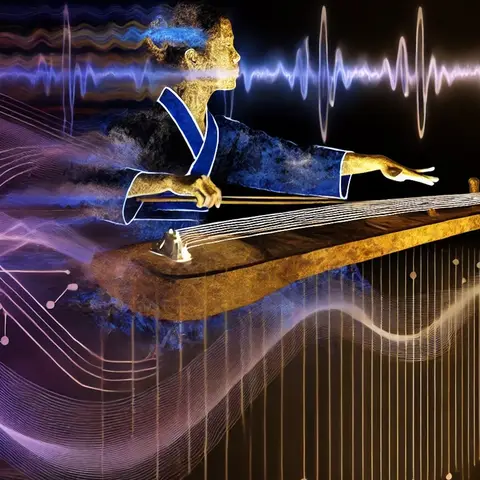
In this paper, we propose a method for utilizing musical artifacts and physiological data as a means for creating a new form of live music experience that is rooted in the physiology of the performers and audience members. By utilizing physiological data (namely Electrodermal Activity (EDA) and Heart Rate Variability (HRV)) and applying this data to musical artifacts including a robotic koto (a traditional 13-string Japanese instrument fitted with solenoids and linear actuators), a Eurorack synthesizer, and Max/MSP software, we aim to develop a new form of semi-improvisational and significantly indeterminate performance practice. It has since evolved into a multi-modal methodology which honors improvisational performance practices and utilizes physiological data which offers both performers and audiences an ever-changing and intimate experience.
In our first exploratory phase, we focused on the development of a means for controlling a bespoke robotic koto in conjunction with a Eurorack synthesizer system and Max/MSP software for controlling the incoming data. We integrated a reliance on physiological data to infuse a more directly human elements into this artifact system. This allows a significant portion of the decision-making to be directly controlled by the incoming physiological data in real-time, thereby affording a sense of performativity within this non-living system. Our aim is to continue the development of this method to strike a novel balance between intentionality and impromptu performative results.
https://dl.acm.org/doi/10.1145/3623509.3633356
Transcript 1,745 words
Ever get that feeling? Like music is physically moving you. You know that feeling, right? Yeah. But now, imagine if that feeling wasn't just in your head, but the music itself was actually changing. Wow. Driven by your heartbeat, your sweat, your whole physical response. Now that's a trip. That's really interesting. Yeah. And that's the mind-bending concept we're diving into today. We are diving into some wild stuff.
We're taking a deep dive into innermost echoes, a paper fresh from the bleeding edge of music and tech research. Okay. So, innermost echoes. Yeah. These researchers at Keio University in Japan. Japan, yep. They're blurring the lines of live performance in ways you wouldn't believe. Really pushing the boundaries. Yeah. They've created this system that uses biosensors. Okay. Biosensors, sure. To tap into the physiological responses of both the audience and the musicians.
So, we're talking about literally measuring what the audience is feeling. Yes. Imagine a concert where the music is literally shaped by how the crowd is feeling. Wow. Okay. I'm already hooked. So, we know they're using biosensors. But what are they actually measuring? And how does that data become music? Yeah. How does that even work? Right. Break it down for us. Okay. So, they are measuring things like heart rate.
Okay. And what's called electrodermal activity or EDA. EDA. And that is? That's basically how much you're sweating. Okay. Which can be an indicator of emotional arousal. Right. Right. So, if you're really getting into it. Exactly. You're going to sweat more. Then the music's going to respond. Now, this data is fed into some seriously smart software. That acts like a conductor. Interpreting those biosignals and translating them into instructions for the instruments.
Wait. Hold on. Instruments. Instruments. Like real instruments. Real physical instruments. Tell us about the musical setup here. So, they have a mix of traditional and very high-tech instruments. One of the stars of the show is a robotic koto. A robotic koto. Okay. For anyone who hasn't had the pleasure, what's a koto? So, the koto is a Japanese stringed instrument, kind of like a harp, but with a brighter, more
percussive sound. Okay. Cool. So, imagine this koto being played not by human hands. Okay. But by robotic mechanisms controlled by the software. So, the software is like the musician, essentially. Exactly. Wow. And the software dictates everything. Everything. From the plucking patterns to the actual tuning of the strings. Wow. In real time, based on the data it's receiving from the biosensors. No way.
And alongside the koto, they also incorporate synthesizers, which add another layer of sonic possibilities. So, if someone's heart rate spikes, the music might get faster or more intense. Precisely. Wow. Or, if the collective tension in the room rises, the synthesizers might introduce a sense of dissonance or unease. That's wild. And they experimented with a visual score, too, right? Like, you could even see the collective feeling in the room.
That's amazing. Yeah. Imagine a screen displaying abstract patterns that shift and morph along with the audience's heartbeats or emotional responses. That's another dimension to the music. It adds a whole other dimension to the concept of feeling the music. Wow. So, they've got this technology, but did they compose the music for this, or were the musicians improvising? So, it was a fascinating blend of structure and improvisation.
Okay. They actually brought in a composer to create the framework for the pieces, incorporating elements that could be influenced by the biofeedback. Okay. So, there's a structure, but also room for the music to change. Yes. Yeah. Exactly. This means that there was a clear structure, but within that structure, the music could flow and evolve in completely unique ways, depending on what was happening in the room.
Wow. So, every performance is different. Every single time. It's like that old saying, the music played us. Right. But in this case, it's literally true. Yeah. So, did they have specific pieces composed with this in mind, or was it more of a free-for-all sonic exploration? Well, they did have a few key pieces. That demonstrated the different ways that this bio-driven approach could work.
One was called Ringing, and they used the audience's average heartbeat to dictate the tempo. Wow. So, you literally feel the music pulsing in sync with the room. Yeah. That's wild. It's incredible. You imagine that energy in that space. Yeah. Everyone linked not just by the music, but by their own physiology. Wow. And because it's an average, the tempo could subtly shift throughout the performance, reflecting
the overall ebb and flow of the audience's collective energy. Man. Okay. I'm hooked. Yeah. What other musical experiments did they cook up? All right. So, another piece. Lioness. Okay. It's a really interesting approach. The length of the piece wasn't predetermined. It was actually determined by the performer's heart rate variability. Wait. So, if the musicians were really feeling it, getting into the groove, the song would actually
get longer. That adds a whole other level of intensity to the performance. Yes. It became this incredible feedback loop between the musician's emotional state, the music itself, and the audience's reaction. And then there's floating like dust, which took a different tack altogether. Okay. This piece relied solely on the visual representation of the audience's bio data. Okay. With no direct bio feedback influencing the music itself.
So, in this case, it was more about the visual experience reflecting the collective feeling in the room. Precisely. The musicians had the visual score to interpret. Okay. But the music itself wasn't directly tied to the audience's bio data. Interesting. It allowed for a different kind of interplay between the scene and the herd, creating a unique atmosphere. I can only imagine. So, they've got the tech.
They've got the music. They've even got, we'll say, the bar snacks. But what did the people involved actually think about this whole experience? Yeah. What was the reaction? That's where it gets even more interesting. The researchers interviewed both the musicians and external composers who weren't directly involved to get their perspectives. The musicians, especially after their second performance, reported feeling incredibly connected. Okay.
Describing the experience as more organic and collaborative than they had anticipated. Why do you think that shift happened from the first performance to the second? You know, it likely has to do with the human ability to adapt. Yeah. And find flow, even within unfamiliar or initially intimidating circumstances. Right. Perhaps the first performance involved a level of self-consciousness, of thinking too much about
the technology and its influence. But by the second performance, a certain comfort level had set in. Makes sense. They were no longer just reacting to the technology. They were playing with it, having a musical conversation. Oh, that makes a lot of sense. Yeah. It's like anything new, driving a car, learning an instrument. At first, you're hyper aware of every little thing, but then it clicks and you're just
doing it. Right. What about the composers who weren't directly involved? How did they respond to this concept of bio-driven music? Well, the responses were fascinatingly diverse. Okay. Some composers expressed hesitation, particularly about the visual feedback element, worrying that it might be distracting or compromise their artistic vision. Interesting. Others, however, were completely intrigued by the possibilities. Yeah. Seeing it as a new avenue for exploring human emotion and expression through music.
Yeah. It's like some composers are just hardwired for that structure. Right. That control over every note. Yeah. And then others are more interested in just seeing what happens. Yeah. You know, those emergent possibilities of letting go a little. Exactly. And this technology really highlights those different approaches to creation. It also makes you wonder, though, like, what does it mean for the listener when the music
is literally responding to them? That's so interesting. Would you want to know, going into a concert, that your heartbeat might alter the tempo or that your emotional state could shape the sound? Yeah. Would you want to know? I think part of me loves the idea of a truly immersive experience like that, you know, where it becomes this kind of mirror reflecting the energy of the room that everyone is feeding
into. Where the line between audience and performer starts to dissolve. Exactly. But then there's a part of me, maybe the introverted part, that's like, what if I get anxious and it makes the music screech to a halt? Right. Or what if they know, like, my guilty pleasure pop song based on my biofeedback? Yeah, that gets at a fundamental question about art, doesn't it?
It really does. Is it about pure, unfiltered expression? Yeah. Where do you draw that line? Right. And how would this technology shift that dynamic? Between, yeah, enhancing the experience versus manipulating it. Yeah. It's fascinating. Regardless of where you land on those questions, there's no denying this research opens up a whole world of possibilities. Yeah. The researchers envision this moving beyond just concert halls into museums, galleries, even
therapeutic settings. I was reading about how they want to explore how this could be used for people dealing with anxiety or emotional distress. Imagine music that adapts to your mood in real time, offering a sense of comfort or release. There's something really quite poetic about that, the idea of music as medicine. It is kind of beautiful. It's tailored not just to your taste, but to your very state of being at that moment.
So is this the future of music? Concerts where everyone's hooked up to biosensors, bodies swaying in unison to the rhythm of our collective heartbeat? It's certainly a possibility. And even if bio-driven music never becomes mainstream, I think the very act of exploring these ideas challenges our assumptions about how music is created, experienced, and shared. Yeah. It pushes us to consider the evolving relationship between technology and human expression.
It really does. And on that note, for our listeners who want to experience this bio-driven music firsthand, we will be sure to link to a video of the performance in the show notes. Check it out. Let us know what you think. Is this the future of music or something else entirely? We'd love to hear your take. Until next time, keep exploring, keep listening, and keep those creative sparks flying.