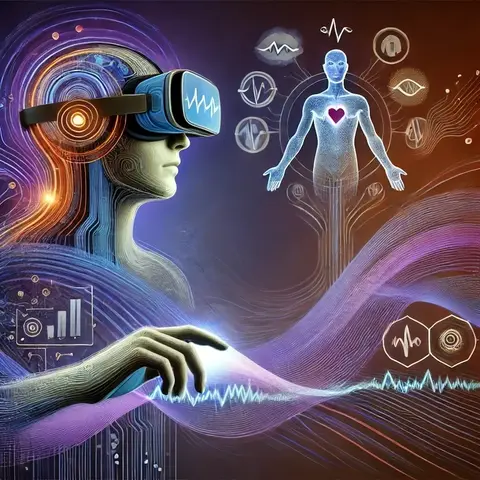
Perceived Empathy in Mixed Reality: Assessing the Impact of Empathic Agents’ Awareness of User Physiological States
Z. Chang et al., "Perceived Empathy in Mixed Reality: Assessing the Impact of Empathic Agents’ Awareness of User Physiological States," 2024 IEEE International Symposium on Mixed and Augmented Reality (ISMAR), Bellevue, WA, USA, 2024, pp. 406-415, doi: 10.1109/ISMAR62088.2024.00055. https://doi.org/10.1109/ISMAR62088.2024.00055
In human-agent interaction, establishing trust and a social bond with the agent is crucial to improving communication quality and performance in collaborative tasks. This paper investigates how a Mixed Reality Agent’s (MiRA) ability to acknowledge a user’s physiological state affects perceptions such as empathy, social connectedness, presence, and trust. In a within-subject study with 24 subjects, we varied the companion agent’s awareness during a mixed-reality first-person shooting game. Three agents provided feedback based on the users’ physiological states: (1) No Awareness Agent (NAA), which did not acknowledge the user’s physiological state; (2) Random Awareness Agent (RAA), offering feedback with varying accuracy; and (3) Accurate Awareness Agent (AAA), which provided consistently accurate feedback. Subjects reported higher scores on perceived empathy, social connectedness, presence, and trust with AAA compared to RAA and NAA. Interestingly, despite exceeding NAA in perception scores, RAA was the least favored as a companion. The findings and implications for the design of MiRA interfaces are discussed, along with the limitations of the study and directions for future work.
Transcript 2,536 words
Welcome back, everyone. Ready to dive into another fascinating research paper? Absolutely. Always ready for a good deep dive. Today we're looking into the world of empathetic virtual agents. Specifically those within mixed reality environments. Ah, yes, because it is not enough to have them on our screens. Exactly. We're talking about near mixed reality agents. They share our 3D space. Let's see a little bit closer, huh?
Much closer. Creates a heightened sense of co-presence. And the paper we're looking at today. It's titled, Perceived Empathy in Mixed Reality. Assessing the Impact of Empathic Agents' Awareness of User Physiological States. Quite a title. What's the core idea? The researchers wanted to see how an agent's ability to recognize and respond to a user's physiological state, things like stress levels, impacts how the user perceives that agent.
Makes sense. You react differently to someone who can tell you're stressed, right? Precisely. For effective human-agent collaboration, especially in things like training or therapy, building trust and a social bond is vital. Empathy is key there. Absolutely. And that's what they're examining in this study. So how do they study this? They designed a game called Drone Rage. Drone Rage? Sounds intense. It's a first-person shooter game where the player combats waves of drones using a VR controller as a virtual gun.
So classic shooter setup. But where does the agent come in? That's the interesting part. They introduced a virtual agent companion. Okay, so you're fighting drones and you have this agent with you. What does the agent do? It depends on the condition. They had three different agent conditions. Three different types of agents. Okay, tell me of them. First, there's the no-awareness agent, or NLA. This agent ignores your stress levels completely.
Just focuses on the game. Yes. Praises your shooting, but doesn't acknowledge your emotional state. Got it. What about the second type? The random awareness agent, or RAA. This one is a bit unpredictable. Sometimes it acknowledges your stress. Okay. Sometimes it's inaccurate. Sometimes it ignores it completely. So it kind of hit or miss. Exactly. And finally, we have the accurate awareness agent. I bet I can guess. This one is always spot on.
Exactly. The AAA accurately detects and comments on your stress levels throughout the game. Fascinating. So three very different approaches to empathy. And by using these varying levels, the researchers could isolate the impact of empathy on the player's experience. Smart. Makes sense. But how did they actually measure this impact? They used established questionnaires to assess user perception in a few key areas. Okay, like what?
Well, they were interested in perceived empathy. How lifelike, intelligent, and understanding of emotions the agent appeared. So did it feel like the agent could actually get them? Exactly. They also measured social connectedness. Whether interacting with the agent made the player feel more connected to it. Did it feel like a companion? Precisely. And they looked at social presence. Whether the agent felt like a real presence in the virtual space, paying attention and understanding the player.
I can see how those will all be important. They are. And of course, they examined trust. Whether the agent's accuracy in perceiving empathy influenced the player's level of trust in it. So did being accurately seen by the agent make a difference? It did. That's one of the key findings. Awareness is good. Both the RAA and AAA scored higher on social connectedness and certain aspects of social presence compared to the NAA.
So even if the agent was sometimes wrong about your feelings, it was still better than no acknowledgement at all? It seems so. Even some awareness, even if it's not always accurate, had a positive effect. Interesting. What about the AAA? The agent that was always accurate? This is where it gets really compelling. The AAA outperformed both the NAA and the RAA in perceived empathy, trust, and most aspects of social presence.
So being accurately seen and understood by the agent really mattered to users. Yes. And that's a crucial insight for designing these types of agents. People want to feel understood even by a virtual entity. Makes you think about the future of virtual assistants and companions. But let's dig into some of the more specific findings. Why was the random awareness agent, the RAA, the least liked?
The participant interviews offer some clues. Quotes from those interviews show that the agent's inconsistency, sometimes being aware, sometimes not, created a lot of frustration and mistrust. So it's better to have no acknowledgement of your feelings than to have inconsistent, unreliable acknowledgement. That seems to be the case, at least in this study. It raises a big question about privacy, too. Participants had mixed feelings about sharing their physiological data with a virtual ager.
I can imagine. Some people might be okay with it, while others might find it intrusive. Exactly. Some embraced it, seeing the potential benefits, while others had strong reservations. Even in virtual spaces, those boundaries of personal space and data privacy are important. Absolutely. And what about the uncanny valley? Did any participants find the agent's level of perceptiveness unsettling? Yes. There were instances where participants reported feeling uneasy when the agent seemed too insightful, too accurate in its assessments.
They described it as creepy or invasive. There's a fine line there, isn't there, between helpful empathy and unwanted intrusion. There is. And that's something we need to consider carefully as we design these increasingly sophisticated virtual agents. So it seems we instinctively want to have some control over how much we reveal, even to a virtual being. It does. It makes you think about how all this could be used to create real-world MRAs.
MRAs. Empathetic MRAs. Imagine virtual therapists or trainers who can actually perceive and respond to your emotional state. That could be pretty powerful. It could be transformative. Think about educational settings, where an MRA could provide personalized support to students, changing its approach based on whether the student is stressed or frustrated. Or in healthcare. Yeah. An MRA could help patients manage chronic pain or anxiety, providing encouragement and guidance, but in a way that feels truly understanding.
Precisely. The potential applications are vast. But as this study shows, we need to be thoughtful about how we develop these systems. Yeah. It's not just about slapping some physiological sensors onto a virtual agent. We need to think about the ethical implications, about privacy concerns, and about the potential for discomfort if these agents get too good at reading us. Exactly. It's a delicate balance between creating a truly helpful and supportive experience and inadvertently crossing into a territory that feels intrusive or unsettling.
This research gives us some really valuable insights for navigating that balance. It highlights the importance of accuracy, consistency, and respect for user boundaries. And it really underscores the power of even subtle expressions of empathy in shaping how we perceive and interact with these virtual agents. It really does. And the researchers go into some detail about the technical setup they used. Oh. Tell me about that.
They used the MetaQuest 3 headset along with Shimmer 3 GSR Plus sensors to collect data on the player's skin conductance levels. Skin conductance. It's a way of measuring emotional arousal. It's a good indicator of stress. Okay. So they're tracking stress levels. Anything else? They also looked at perspiration levels, another physiological response to stress. They were very meticulous in their approach, carefully calibrating the system to ensure accurate and reliable measurements.
Sounds like they went to great lengths to make sure everything was working properly. They did. They even developed multiple variations of the agent's speech, using synonyms and things like that. To make it sound more natural? Precisely. To avoid repetition and make the interactions flow more smoothly. Interesting. So they're tracking stress levels. They've got this carefully calibrated system. And they're making sure the agent sounds natural.
Did they notice any differences in the participants' physiological responses based on which agent they were interacting with? They analyzed things like electrodurnal activity and heart rate variability. But surprisingly, they didn't find any significant differences between the agent conditions. So it didn't matter which agent you were interacting with, your stress levels were basically the same. That's what the data suggests. It seems that the participants' physiological responses were mostly driven by the challenges of the game itself.
So the game itself was stressful enough that it kind of overshadowed any differences in how the agent was behaving. It appears so. It highlights the complex interplay between our conscious perceptions, our feelings about the situation, and our underlying physiological responses. Right. Because even though the agent's behavior didn't directly change their stress levels, it did influence how they felt about the experience. Exactly. And the researchers also looked at the qualitative data they gathered through post-experiment interviews.
Asking the participants about their experience, I presume? Yes. They asked about their preferences, their comfort levels with data sharing, their overall thoughts on empathetic virtual agents, that kind of thing. Makes sense. They can give you a lot of insight that you wouldn't get from just looking at numbers. Right. What stood out to you in those interviews? The responses about privacy were really striking.
A lot of participants said they were willing to share their data, but only if they felt it was being used to improve their experience. Right. If it was benefiting them in some way. Exactly. Or if it was giving them valuable feedback. But there was a strong emphasis on transparency and control. They wanted to know how their data was being used and have the option to say no.
Precisely. Which makes sense. If you're going to share something as personal as your physiological data, you want to know what's happening with it. Of course. And what about their expectations for the empathetic responses themselves? Do they have any thoughts on that? They did. They wanted agents that could not only recognize their emotional states, but also respond in a way that was helpful.
So not just saying, I see you're stressed, but actually offering some kind of support. Exactly. They wanted encouragement, guidance, or even just a listening ear. They wanted to feel seen, understood, and cared for, even by a virtual entity. It's really about that need for connection, isn't it? Even if it's with a virtual agent. But what about that uncanny valley effect we talked about earlier?
Did anyone feel uncomfortable with the agent's level of perceptiveness? There were a few participants who said they felt a bit uneasy when the agent seemed too insightful. Too accurate in its assessments. They used words like creepy or invasive. It's a tricky balance, isn't it? Hitting that sweet spot between helpful empathy and overstepping boundaries. It is. And the researchers offer some good design recommendations based on their findings.
Oh? Like what? They emphasize the importance of carefully calibrating the agent's level of empathy, making sure it feels supportive without becoming overbearing. Right. So it's not just about making the agent as empathetic as possible. It's about finding the right level of empathy for the situation. Exactly. And they also stress the need for transparency and user control, giving people the ability to decide how much they want to share and how they want the agent to respond.
It's about empowering people to feel comfortable with the technology rather than feeling like it's controlling them. Precisely. It's all about finding that balance between personalization and privacy, between creating a truly engaging experience and respecting individual boundaries. This research has really given us a lot to think about. It's shown us the incredible potential of empathetic virtual agents to change how we interact with technology.
But it's also reminded us of the ethical considerations we need to keep in mind. It has. And it's a field that's just going to keep evolving. I'm fascinated to see where it goes next. Me too. It feels like we're on the cusp of a whole new era of human-computer interaction, one where our emotions and well-being are front and center in the design process.
It's an exciting time to be working in this field. But before we get too carried away with the possibilities, it's important to acknowledge the limitations of this particular study. Of course. Every study has its limitations. What were some of the limitations here? Well, one limitation the researchers point out is that the virtual agent's communication was relatively simple. Simple. In what way? It relied mostly on verbal cues. It didn't have a lot of nonverbal expressiveness.
So no body language or facial expressions. Correct. And in real-world interactions, those nonverbal cues are really important for how we perceive and interpret emotions. So it's possible that the agent's empathy could have had an even bigger impact if it had been able to express emotions in a more nuanced way. It's definitely a possibility. It raises the question of how advancements in virtual agent animation and expressiveness might affect these findings.
Right. As the technology gets better, we can see even more realistic and expressive virtual agents, which could really blur the lines between the virtual and the real. Exactly. It makes you wonder how we'll adapt to a world where our digital companions are increasingly attuned to our feelings. What new social norms and ethical considerations will arise? It's definitely a new frontier full of exciting possibilities, but also potential challenges.
This research is a good reminder to proceed with caution, with empathy, and with a deep respect for human connection. Well said. And as we delve deeper into this uncharted territory, it's a question worth pondering. If you were designing an empathetic virtual agent, what additional features or capabilities would you prioritize to create a genuinely engaging and helpful experience? It seems this research is laying the groundwork for more sophisticated studies down the line.
Imagine incorporating things like facial expressions. Oh, interesting. Voice analysis. Okay. Even eye tracking. To get an even richer understanding of how human emotions and virtual agent behavior interact. As technology improves, we can expect even more realistic virtual agents. Oh, for sure. Ones that really blur the lines between the virtual and real. And it makes you wonder. About. How we will adapt to a world where our digital companions are so in tune with our feelings.
What new social norms and ethical issues will pop up. It's a whole new frontier. It is. Full of incredible potential, but also some potential pitfalls. This research is a valuable guide, though. Definitely. And it reminds us to proceed thoughtfully. I can't believe. And a deep respect for that human connection. If you were designing an empathetic virtual agent, what would you prioritize to create a truly engaging and helpful experience?
Hmm. Something to think about as we move forward into this exciting new world. It is. Well, that about wraps up our deep dive into empathetic virtual agents. Fascinating stuff. Always so much to explore in this field. Absolutely. To our listeners, thank you for joining us. And until next time, keep exploring.