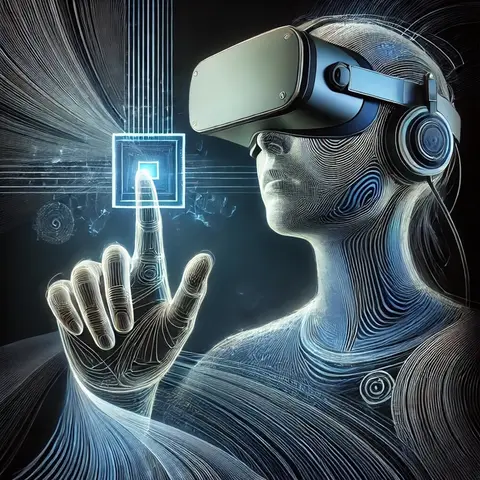
Best Paper Award: Integrating Force Sensing with Electro-Tactile Feedback in 3D Printed Haptic Interfaces
We deep dive today into the ISWC 2024 best paper award.
Tactile feedback mechanisms enhance the user experience of modern wearables by stimulating the sense of touch and enabling intuitive interactions. Electro-tactile stimulation-based tactile interfaces stand out due to their compact form factor and ability to deliver localized tactile sensations. Integrating force sensing with electro-tactile stimulation creates more responsive bidirectional systems that are beneficial in applications requiring precise control and feedback. However, current research often relies on separate sensors for force sensing, increasing system complexity and raising challenges in system scalability. We propose a novel approach that utilizes 3D-printed modified surfaces as the electro-tactile electrode interface to sense applied force and deliver feedback simultaneously without additional sensors. This method simplifies the system, maintains flexibility, and leverages the rapid prototyping capabilities of 3D printing. The functionality of this approach is validated through a user study (N=10), and two practical applications are proposed, both incorporating simultaneous sensing and tactile feedback.
https://dl.acm.org/doi/10.1145/3675095.3676612
Transcript 1,599 words
We interact with the world through touch all the time. But, like, have you ever thought about recreating that digitally? It's kind of wild when you think about it. It's called haptics. Right. And it's all about recreating those touch sensations. Exactly. Like, imagine being in a virtual world and actually feeling the texture of a brick wall. Oh, wow. Or the weight of, like, a virtual object in your hand, you know?
It's pretty amazing what we're essentially trying to do is kind of trick your brain. Yeah. Your sense of touch into feeling something that's not actually there. It's, like, digital magic for your sense of touch. Right. And get this. Our deep dive today is on some really cool research by Pereira and their team presented at ISWC24. Yeah. They found a way to make haptic interfaces.
Uh-huh. Those devices that let us feel digitally. Yeah, yeah. Even more sensitive. Wow. And responsive. That's awesome. Yeah. So much of, like, haptic tech uses vibration. Right. You know, like the rumble pack in your game controller. Right. But this research uses something called electrotactile stimulation. Okay. Which is, like, a way more precise and potentially, like, game-changing way to create these sensations. Okay.
Hold on. Got to geek out for a second.
Electrotactile stimulation. Yeah. For those of us who haven't gone full cyborg yet, what are we talking about? So, imagine the feeling of a tiny, really localized tingle on your skin. Okay. So, it'd be, like, if your phone vibrated, but on, like, a much smaller, more controlled scale. Gotcha. Yeah. That's essentially what electrotactile stimulation does. Okay. Instead of just, like, a general buzz, it uses these tiny electrical pulses to create a much wider range of sensations on your skin.
Wow. It's, like, the difference between listening to music through, like, a tiny little speaker. Yeah. And, you know, experiencing a live orchestra. Yeah. Is that much more nuanced. So, instead of just feeling, like, a buzz, I could feel the difference between, say, silk and sandpaper in the virtual world. Yeah, you got it. And because we're talking about electrical pulses, the hardware can be way smaller.
Right. And more flexible. Okay. Perfect for wearables. Right. All sorts of cool applications. So, what's the catch? Hmm. Because it sounds almost too good to be true. So, electrotactile stimulation is already impressive as it is. Right. What were Pereira and their team trying to improve? Well, that's the really ingenious part. Okay. Imagine you're in a VR game. Yeah. And you pick up a virtual object.
Right. Now, for that to feel real. Yeah. The game needs to know how hard you're squeezing. Right. Right. Yeah. Traditionally, electrotactile devices rely on additional sensors to actually measure the pressure you're applying in VR. These sensors add a lot of complexity and bulk to the design. Yeah. Okay. So, they thought, how can we get rid of that? So, they're trying to, like, ditch the extra sensors, make things sleeker.
Yeah. I like where this is going. Like it's simpler. Yeah. How'd they do it? Well, they asked a really brilliant question. Okay. What if the surface itself could actually feel how much pressure you're applying? Now, that's thinking outside the box. Yeah. Okay. No extra sensors, just like a smart surface. Exactly. Tell me more. So, it's all about texture. Okay. And this is where the 3D printing comes in.
Okay. They created these surfaces with microscopic patterns, almost like tiny little waves on them. Okay. Imagine running your fingers over, like, a slightly bumpy surface. Yeah. That's the kind of scale we're talking about. Okay. Yeah. And as you press harder, more of your skin comes into contact with those tiny little bumps. And that's what they measure. So, the harder you press, the more contact.
And that, like, translates to a force measurement. Exactly. Mind-blowing. Yeah. By analyzing those subtle changes in contact, they can tell exactly how much pressure you're applying. Wow. All without those bulky extra sensors. That's crazy. Yeah. So, a really elegant solution. This is incredible. But, did it work in practice? Like, did they run any tests? Yeah, they did. Okay. They had a group of 10 volunteers try out the tech.
Okay. And the participants had to apply, you know, specific amounts of pressure. Right. Well, the system measured their force. Mm-hmm. And sometimes, it would provide that electro-tactile feedback. Okay. So, it's like a high-tech version of that carnival game where you have to guess how much something weighs. Right. Exactly. I can picture it. Yeah. Yeah. So, did this new system pass the test?
What kind of feedback were they getting? It was really interesting. Yeah. One of the participants mentioned feeling confused during the trials. Yeah. Especially when the feedback was, like, turned on and off. Oh, wow. Yeah. And it really highlights how quickly our brains adapt to new sensations. Right. When we're constantly exposed to something. Even something as subtle as, like, this electro-tactile feedback. Yeah.
Our brains just learn to silt it out. Yeah, totally. But then when it's gone, we kind of become really aware of its absence. That's so interesting. It's, like, how you get used to the feeling of your clothes on your skin. Exactly. Throughout the day, your brain just, like, dooms it out. Right. Okay. So, brain tricks aside, what were the overall results of the study?
Well, the system actually worked. That's awesome. They were able to accurately measure the force applied. Wow. Just using the texture of the surface. Okay. And the electro-tactile feedback was definitely noticeable. Right. It wasn't perfect, though. Oh, okay. The system was most accurate at, you know, medium pressure levels. Oh, God. The kind of pressure you'd use to hold a pen or type on a keyboard.
Right. Okay. But for really light presses. Yeah. Or really strong presses, the accuracy dropped off a little bit. So, they're on the right track. Yeah. This could be huge. But I'm sure our listeners are wondering, like, what can we actually do with this? Where does it fit into the bigger picture? Well, that's where things get really exciting. Imagine a world where you can actually feel the texture of a dinosaur bone.
Oh, wow. While exploring a virtual museum. Yeah. From your couch. That'd be amazing. Or a surgeon. Yeah. Practicing a really delicate procedure on, like, a virtual patient. Mm-hmm. You know, experiencing realistic feedback. Yeah. Without any actual risk. Wow. That's incredible. But you also mentioned something about a gaming application. Right. A wearable ring. Yeah. They actually designed a prototype ring that uses this tech to create super immersive gaming experiences.
Mm-hmm. Imagine playing Fruit Ninja, right? Yeah. And you can actually feel the resistance of slicing through each piece of fruit. Oh. With that satisfying little zap as you make each cut. That sounds amazing. Right. It's like having an arcade right on your finger. Exactly. But even with all these amazing possibilities. Yeah. There are always limitations, right? Of course. What kind of challenges are they facing as they kind of continue to develop this?
Well, like I said, you know, improving that accuracy at those really extreme pressure levels is really important. Okay. And while they have eliminated the need for those extra sensors. Yeah. The current system still requires, like, a base unit that's a little bit bulky. Right. So making the entire system more compact. Okay. And energy efficient. Yeah. Will be really important for, you know, widespread adoption.
Right. Especially for wearables. Yeah, for sure. So those are some of the things that they're still working on. That makes a lot of sense. So as we kind of wrap up our deep dive into this world of haptics, what's, like, the one big takeaway you want to leave our listeners with? It's not just about, like, perfectly copying touch. It's about going beyond the limits of, like, our physical senses, you know?
You're getting me really hooked on this. Give me the grand vision. Okay. So imagine feeling the texture of a rock. Uh-huh. But not just any rock. A Martian rock. Whoa. And it's being transmitted through a rover millions of miles away. That's wild. Or think about experiencing a Van Gogh painting. Yeah. But instead of just looking at it, you can feel those brush strokes.
Wow. Almost like you're running your fingers across the canvas. Those possibilities are mind-blowing, really. It seems like this could change how we experience the world in huge ways. Absolutely. Yeah. And that's what's so exciting about this whole field. It makes you wonder what would you want to experience if touch wasn't limited by, you know, physical stuff anymore. That's a powerful question to end on.
Right. It really makes you think about the future of our senses. Yeah. And, like, all these amazing experiences that are coming our way, you know. It's going to be wild. Well, thank you so much for taking us on this deep dive into the world of haptics. Of course. Yeah. It was my pleasure. And to all our listeners out there, thanks for tuning in.
Until next time, keep exploring. Yeah. Keep asking questions. Keep those minds buzzing. Yeah. And we'll see you in the metaverse. Bye. Bye. Bye. Bye. Bye.
Bye. Bye. Bye. Bye. Bye. Bye. Bye. Bye. Bye. Bye. Bye. Bye. Bye. Bye. Bye. Bye. Bye. Bye. Bye. Bye. Bye. Bye. Bye. Bye. Bye. Bye. Bye. Bye. Bye. Bye. Bye. Bye. Bye.