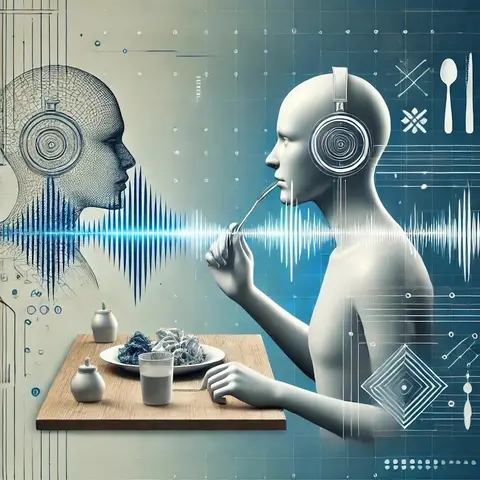
Honorable Mention: EchoGuide: Active Acoustic Guidance for LLM-Based Eating Event Analysis from Egocentric Videos
We deep dive today into an ISWC 2024 Honorable Mention.
Self-recording eating behaviors is a step towards a healthy lifestyle recommended by many health professionals. However, the current practice of manually recording eating activities using paper records or smartphone apps is often unsustainable and inaccurate. Smart glasses have emerged as a promising wearable form factor for tracking eating behaviors, but existing systems primarily identify when eating occurs without capturing details of the eating activities (E.g., what is being eaten). In this paper, we present EchoGuide, an application and system pipeline that leverages low-power active acoustic sensing to guide head-mounted cameras to capture egocentric videos, enabling efficient and detailed analysis of eating activities. By combining active acoustic sensing for eating detection with video captioning models and large-scale language models for retrieval augmentation, EchoGuide intelligently clips and analyzes videos to create concise, relevant activity records on eating. We evaluated EchoGuide with 9 participants in naturalistic settings involving eating activities, demonstrating high-quality summarization and significant reductions in video data needed, paving the way for practical, scalable eating activity tracking.
https://dl.acm.org/doi/10.1145/3675095.3676611
Transcript 2,444 words
What if, and just hear me out on this, what if tracking your meals was as easy as just putting on a pair of glasses? Like no more food journals or apps. Exactly. Imagine like total food freedom, but you're still totally on top of your nutrition. That's what today's deep dive is all about. We're diving into some cutting edge research from, let me get this right, the 2024 ACM International Symposium on Wearable Computers.
Catchy, right? Definitely rolls right off the tongue. But seriously, they're doing some really cool stuff. And the paper we're looking at today is about this system called EmboGuide. Ecoguide. I'm intrigued. It's some pretty wild tech, but don't worry, we're going to break it all down for you. Yeah, because let's be real, we could all use a little less tech jargon in our lives.
100%. But before we get too deep into Ecoguide, let's talk about why this whole thing even matters. Like, why go to all this trouble to track what we eat? Right, because at the end of the day, it's all about, well, the food, right? Yeah. Exactly. Tracking what we eat can be a game changer for our health. But let's be honest, the ways we do it now are, well, a little clunky, to put it mildly.
Yeah, who actually enjoys meticulously logging every single bite into an app. It's like a part-time job. And let's not even talk about those moments when you completely forget what you ate for lunch. Oh, tell me about it. Was it a salad? A sandwich? Did I even eat lunch? It's the worst. And even when you do remember, you're probably underestimating portions or forgetting key ingredients.
It's so easy to do. And that's where technology should come in to save the day. And there are some smart glasses out there that try to do just that. They can actually tell when you're eating. Okay, that's cool, I guess. Yeah. But do they actually tell you what you're eating? Because that seems like the important part. That's the million-dollar question. And unfortunately, most of them don't.
They miss the what, which, let's be real, is a pretty big oversight. It's like they skipped a step or something. Right. Plus, and this is another biggie, having cameras record constantly. Talk about draining your battery life. Yeah, nobody wants to be tethered to a charger all day. Exactly. So researchers have been trying to come up with, like, smarter ways to capture that eating data
without needing to record 24-7. Makes sense. So what have they come up with? What are the alternatives? Well, some have been looking at using EMG sensors. EMG. For food. Yeah, so EMG measures muscle activity, right. So they're basically trying to pick up on the signals your muscles send when you chew. Wow. Okay, I never thought about it like that. So it's like eavesdropping on your jaw muscles or something.
Exactly. And there's more. Some are even using piezoelectric sensors. Geza what now? I know, it sounds complicated, but it's actually pretty cool. There are these tiny sensors that pick up on vibrations. So when you chew, they can detect those tiny vibrations from your teeth and jaw bone. That's wild. So we've got muscle signals, vibrations, anything else. Oh, yeah. They're even using microphones to analyze the sounds of eating.
Seriously. Yeah. Like the crunch of a chip or the slurp of a smoothie. Exactly. It sounds kind of crazy, but it makes sense, right? It does, actually. But I have to ask, even with all of that, they're still not telling you what you're actually eating, right? You're exactly right. They can tell that you're eating, but they don't capture those crucial details about the food itself.
So what's the point? What good is knowing when you ate if you don't know what you ate? I know, right? It's like a detective showing up to a crime scene after all the evidence is gone. It's the information we need to understand our eating habits and maybe even make some positive changes. Totally. So is that where Echo Guide comes in? Does it finally crack the code?
That's where Echo Guide steps in. It's like food tracking 2.0. It goes way beyond just telling you when you ate to actually figuring out what you're eating. Okay. Now you're talking. Finally, some answers. Get this. It uses a really clever combination of sound and artificial intelligence. Sound and AI. Now that's a combo I haven't heard before. This is where things get really interesting, right?
This is where it gets really, really cool. So you're wearing these glasses, right? Okay. I'm picturing myself in some sleek, futuristic frames. Exactly. But hidden inside these glasses, there are these tiny speakers and microphones, like seriously tiny. Hidden tech. I'm all about it. So what do they do? Well, they work together to send out sound waves and listen for the echoes that bounce back.
Wait. So like sonar, but for your food. Exactly. That is brilliant. I know, right? It's using sound to see what you're eating, even when the camera isn't recording. Okay. That's seriously cool. But how does it know what those echoes even mean? Well, that's where the AI comes in. All of that acoustic data is being analyzed in real time by these super sophisticated AI models that have been trained to recognize the subtle sounds of eating.
All of the sounds of eating, what, like the clinking of a fork or something? Yeah. Like bringing a fork to your mouth, cheering, taking a sip of a drink, even just picking up a piece of food. All of those motions make distinct sound patterns that the AI can pick up on. That is wild. They can tell what you're doing just by the sound.
Pretty much. It's like having a sixth sense for food. So I'm going to ask the tough questions here. Doesn't having all of that going on constantly, like, absolutely kill the battery life? That's a great question, and it's something the researchers definitely thought about. And this is where Echo Guide gets really, really smart. Instead of recording video constantly, it only activates the camera when it detects those eating motions we were just talking about.
So it's like it knows when to pay attention and when it can take a break. That's really clever. It's super efficient, and it saves a ton of power compared to always-on recording. They call this targeted recording. Targeted recording. I like it. It's like having a super-focused camera operator who only hits record at the exact moment something interesting happens. Precisely. So now you've got these short little video clips of, like, key eating moments.
Okay, great. But how do we get from those clips to actually knowing what's on the plate? All right, so this is where things get even cooler. All right, so this is where things get even cooler. We've got these short little video clips of, like, key eating moments, but there's a lot more to it than that. They actually use a really powerful type of AI called a, get this, video captioning model to analyze those clips.
Video captioning. So it's like adding subtitles to the video, but for food. It's kind of like that, but way more advanced. The model they use is called, and I hope I'm pronouncing this right, Lavila's narrator. Lavila's narrator. It sounds like a storyteller from, like, a mythical land of food or something. Right, but seriously, this model is really good at watching those videos and describing what's happening, almost like a person narrating a scene.
And from those descriptions, it can identify specific foods and even actions. So it's not just recording. It's watching and understanding, like a foodie AI or something. Exactly. They've really tapped into something special here. So walk me through this. Let's say I'm part of this study, wearing these high-tech glasses, enjoying my lunch. What happens next? So Echo Guide is busy capturing those key moments, those little video snippets of you eating.
And then Lavila's narrator steps in, analyzes those clips, and creates these really detailed descriptions of everything that's going on. The researchers call these activity records. Activity records. It's like a food diary that writes itself. Sign me up. This is way better than me trying to remember what I ate for breakfast. Right. No more guessing games. No more relying on those vague food memories.
So we've got the glasses, the targeted recording, and these super detailed activity records. But did it actually work? Yeah. Did it really capture everything? That's the million-dollar question, right. And to find out, the researchers had nine participants wear the Echo Guide prototype while they went about their daily lives. Hold on. Prototypes. So are we talking like a clunky early version here? Yeah.
So for this study, they were still using a GoPro for the video recording. So picture this. Nine people going about their day eating meals with a GoPro strapped to their glasses. Oh, wow. I bet those participants got some looks. But hey, for the sake of science. Exactly. But in all seriousness, they really wanted to put Echo Guide to the test in a real-world setting.
And to measure how well it worked, they looked at two main things. First, they wanted to see how much data Echo Guide actually saved compared to recording video constantly. Right. Because battery life is still a thing. So how did it stack up? Well, get this. On average, Echo Guide reduced the amount of video data recorded by a whopping 68% compared to continuous recording.
And some participants even saw reductions of up to 95%. 95%. That's incredible. It's like they're basically squeezing an entire movie's worth of data into like a five-minute short film. Exactly. And it all comes down to that targeted recording. They're only capturing what they need when they need it. Smart. So less is definitely more in this case. But hold on. A summary is only useful if you can actually find the information you need, right?
Were they expecting people to read through pages and pages of descriptions like person eating pasta, person taking a bite? That's where the second part of their evaluation comes in. They also wanted to see if Echo Guide could actually answer specific questions about those recorded meals. Like what did they eat? What utensils did they use? Things like that. So it's like having a food detective who can go back and analyze those activity records for clues.
Exactly. And to do this, they used some pretty advanced AI techniques. I won't go into all the technical details, but they essentially created a way to search those activity records and pull out the precise pieces of information needed to answer those targeted questions. Okay, that's cool. So they have these super detailed summaries, and they have a way to actually make sense of them.
Hmm. But did it work? Was it actually accurate? That's the big question. And the short answer is yes, it actually worked really well. Really? It could accurately answer questions about what people were eating just from analyzing those little video snippets. It did. They were able to identify specific foods, utensils, you name it. That's amazing. It really lived up to its promise. That's amazing.
It really lived up to its promise. But like with all cool new tech, I'm sure there are still some things they need to figure out before this becomes like an everyday thing, right? Oh, absolutely. Especially when you're talking about something people are going to wear. Comfort and style. Comfort and style. Those are biggies. And I got to say, that whole GoPro strapped to your face thing, not exactly the most fashionable look.
Yeah, not exactly what I picture when I think wearable tech. Right. And, you know, the participants in the study actually mentioned that the prototype wasn't exactly comfortable to wear either. Yeah, I can imagine. So not quite ready for its close up, but hopefully they'll get the comfort and style figured out soon. Oh, definitely. And it's just a matter of time before we see more sleek, integrated designs.
Like, imagine Echo Guide built into a stylish pair of sunglasses. Maybe even something like those Meta Ray-Bans, but with even better battery life. Okay, now you're talking. Fashionable, A&D, functional, count me in. But what about the software side of things? Are there any hurdles there? Yeah, for sure. One of the big ones is processing speed. Like, for Echo Guide to be really seamless, they've got to get those video snippets analyzed in real time.
Right now, there's still a bit of a lag, but as AI chips get more powerful and, like, internet speeds improve, I think that lag's going to become less and less noticeable. So it's all about smaller, faster, smarter, right? Sounds like the story of tech. Pretty much. But here's what I think is super interesting. As this technology gets better and better, it starts to raise some pretty big questions about how we view food, our health, and even technology itself.
Like, imagine a world where tracking everything you eat is just something everyone does. It's definitely something to think about. I mean, on the one hand, easier tracking could lead to healthier choices. Maybe it could even help prevent chronic diseases, which would be huge. Right. But on the other hand, it could start to feel kind of intrusive. Like, is Big Brother watching every bite I take?
Exactly. And will we become too reliant on technology to make decisions for us, even about something as basic as eating? Yeah. Will we lose touch with our own internal cues, those natural feelings of hunger and fullness? These are questions we're all going to have to grapple with as this tech becomes more commonplace. It's true. Every advancement brings new questions and challenges. Well, a huge thank you to the researchers behind Echo Guide for giving us a glimpse into the future.
It seems like we're on the verge of a real revolution in wearable tech and how it can help us live healthier, more informed lives. It's exciting to see where it all goes, right? Who knows what they'll come up with next? I can't wait to find out.
That's it for today's deep dive into the world of Echo Guide and the future of food tracking. Thanks for joining us, and we'll catch you next time.
Thank you.