MindSpace: Improving Relaxation Break and Performance Using Deep Touch Pressure on Users’ Upper Chest Area
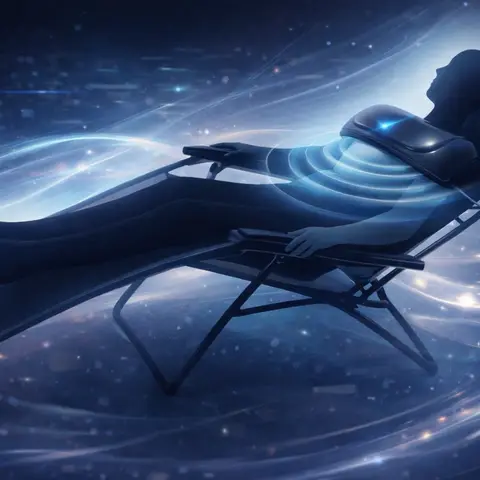
Taking a break at work should leave you refreshed—but often it doesn't. MindSpace is a pneumatically controlled haptic device worn on the upper chest that combines two calming sensations: gentle breathing-like movements and deep touch pressure similar to a hug. In a study with 24 participants performing demanding cognitive tasks, those who used MindSpace during their breaks showed significantly faster recovery of focus compared to those who simply rested. The device simulates the comforting sensation of being held while breathing together with someone, activating the parasympathetic nervous system to reduce stress. Participants reported feeling more relaxed and ready to return to work. This research suggests that active haptic interventions during breaks could be more effective than passive rest for restoring cognitive performance.
Masaki Kikuchi, Kaining Chen, Robert Panskus, Dingding Chen, Kazuki Okawa, and Kai Kunze. 2025. MindSpace: Improving Relaxation Break and Performance Using a Device Exerting Tactile Sensation of Life-like Breathing Movement with Squeeze-like Deep Touch Pressure on Users' Upper Chest Area. In Proceedings of Mensch und Computer 2025 (MUC '25). ACM, New York, NY, USA, 255-269. https://doi.org/10.1145/3743049.3743054
Transcript 2,379 words
Welcome to the Deep Dive. For you, the core challenge of modern existence is, well, just maintaining focus. And achieving any kind of genuine rejuvenation. Exactly. When the lines between your professional and your personal life are continually blurred, remote work and constant connectivity, they've made true disengagement almost impossible. We're left feeling perpetually depleted. Our sources today point to a solution that's almost hidden in plain sight. The micro break.
These are brief pauses, just a few minutes, and they're proven to restore cognitive resources. But for this to work, the pause has to be deliberate. It has to be. It requires activating the parasympathetic nervous system. The body's involuntary relaxation response. The whole rest and digest mode. That is the crux of the matter. The difficulty is engineering a micro break that is truly restorative.
You can't just scroll or close your eyes. So you need a mechanism that compels a physiological shift. Precisely. Yeah. Something that guides you toward a deep embodied state of calm that goes beyond just, you know, visual or auditory stimuli. And that pursuit of an embodied state is exactly the focus of this deep dive. We are analyzing the mind space research from Moose 25.
Okay. The study explores a pneumatically controlled haptic device. It's a piece of technology that applies deep touch pressure and it simulates lifelike breathing. So our mission here is to dissect how this multisensory approach affects the user's relaxation response. And crucially, how it impacts their performance when they return to a demanding task. To appreciate the device, we should probably start with its foundational design.
It synthesizes two proven principles from therapeutic and physiological research. Let's start with the first one. The first is deep touch pressure or DTP. This is a firm tactile sensory input. It's known globally for its powerful calming effects. And it's used in clinical context, right? To manage anxiety and oversensitivity. It is. The physical compression provides this steady, reliable input that, well, it just quiets the nervous system.
Okay. So that's the pressure component. What's the second principle? The second is breathing regulation. It is a well-established fact that slow-paced guided breathing significantly reduces physiological stress markers. I think many of us have experienced that. We have. Research consistently shows that a respiratory rate between four and six cycles per minute triggers specific autonomic responses. Such as? Lowering blood pressure and enhancing heart rate variability, which is a powerful metric for measuring improved parasympathetic tone.
So Mindspace isn't just an app that tells you when to breathe. No. And it's not just a weighted blanket. It's a dynamic physical synthesis of these two potent techniques. Yes. Designed specifically for micro-break restoration. You could almost think of it as a physical focusing agent. It uses embodied input, actual physical sensation to guide you toward a relaxed state without you having to think about it.
But I suppose the question is, why build complex machinery? Why not just use a timer and take deep breaths yourself? That is an excellent point. The research suggests the complexity is necessary to mimic a human interaction while maintaining very precise control. Okay. Let's get into that. The implementation. The prototype has three key parts. There's the zero-gravity chair, which ensures everyone rests in a neutral posture.
Then you have the Mindspace arm itself. And the external air pump system that orchestrates the movement. Right. And the Mindspace arm features some very careful material selection. Its inner pneumatic actuator is made from something called EcoFlex 00030. And why that specific material? This silicone was chosen for its elasticity and weight. They work together to imitate the softness and feel of human skin and touch.
And there's more to it than just the material. Yes. The bottom side of the actuator is covered with an unstretchable fabric. This construction ensures that when the device inflates, it causes a precise bending or wrapping motion. Creating a comfortable, compressive grip around the user's upper chest. Exactly. And its placement is critical, I presume. It is. The actuator is positioned high on the user's upper chest, with its edge aligned with the shoulders.
So that targets a region central to breathing. And notably also a region linked to emotional comfort and expression. The goal is to maximize that sense of enveloping touch. The whole device is driven by an automated external air pump system. This uses a combination of four 500-milliliter vacuum syringe pumps and a linear actuator to execute the movement. And here is where the technical precision meets the physiological mandate.
The system is programmed to operate at a frequency of 3.33 breaths per minute. Which sounds very specific. It is. The rhythm is achieved by programming the linear actuator to extend and retract for exactly 9 seconds during each phase. So that's an 18-second cycle. An 18-second cycle. And 3.33 breaths per minute is exactly 5 full cycles every 60 seconds. As we establish that 4 to 6 cycles per minute range is the optimal zone for parasympathetic activation.
So the engineering is justified. It's hitting that physiological target precisely. Mm-hmm. The cycle delivers about 1.8 liters of air volume to provide the required soft yet substantial deep touch pressure. So we have a machine calibrated for ideal physiological calm. The next logical step is to see if it works. Right. The researchers conducted a within-subject study with 22 participants. And you, the listener, should note that a within-subject design is powerful.
It is because every participant serves as their own control. They experience both conditions. Resting with mind space and resting without it. The protocol was designed to be relevant to a demanding work environment. The task used to induce cognitive fatigue was the Stroop test. Which requires high levels of selective attention and conflict resolution. It's mentally taxing. This test was given immediately before and immediately after the six-minute rest periods.
And during the rest, participants were in that zero-gravity position wearing soundproof headphones. All to eliminate external variables. The measurement strategy was thorough. It relied on triangulation between self-reported perception and objective biology. Tell us how they measured these elusive states of calm and focus. Subjectively, they used two key measures. First, a 12-item relaxation self-report questionnaire. It assessed six facets of calmness. Mental quiet, aware, at peace, clear, distant, and rested.
And the second measure. They measured cognitive load using the NASA TLX scale. You can think of this as the user's mental fuel gauge. It quantifies perceived workload and effort after the task. And then there's the objective biology. Yes. They measured blood volume pulse, or BVP, features, particularly the raw heart rate, or BPM, and crucially, PNN50. PNN50. What does that tell us? PNN50 is the gold standard metric for heart rate variability.
It tracks the difference between subsequent heartbeats. An increase in PNN50 signals enhanced parasympathetic tone. So it's a measure that the body's brake pedal is engaged, that deep relaxation is underway. A measurable indication, yes. Finally, they used electrodermal activity, or EDA, measured by a skin conductance response, to monitor arousal. Okay, let's get to the findings. Question one. Did Mindspace enhance relaxation? The self-reported results provided a clear, strong affirmative.
How so? The relaxation score was significantly higher following rest with Mindspace. It achieved an average of 0.79 on a scale of Megas 2 to 2. And the control condition, resting without the device. There was virtually no significant change in their reported relaxation scores. The physiology backed this up completely, correct? It did. Heart rate, the BPM, was significantly lower during rest with Mindspace, averaging 80.91 compared to the non-device rest, which averaged 84.46.
That 4 beat per minute difference is substantial for just a 6-minute intervention. It is. It's a strong indicator of a superior calming effect. And that metric for deep parasympathetic activity, PNN50, also provided confirmation. Yes. It was measurably higher in the Mindspace condition, averaging 0.045 compared to 0.040 without the device. This verifies the enhanced rest and digest response. Now, this is where the findings become a bit more complex and perhaps most eliminating.
We need to look at the electrodermal activity data. Right. Here we observed a seemingly counterintuitive outcome. The SCR difference, or EDA peaks, which measure skin conductivity and arousal, increased during rest with Mindspace. Wait a moment. If heart rate dropped and the body's brake pedal, PNN50, engaged, how can arousal also increase? Isn't that a physiological contradiction? If you're calmer, you should be less aroused.
That is the essential insight here. It suggests that the device didn't simply make users drowsy or induce a state of sleepiness. I see. Instead, it generated a phenomenon the researchers termed alert yet relaxed activation. Okay, alert yet relaxed. What does that mean in practice? The tactile focus from the device, that rhythmic compression, guided the users into a physically calm state while simultaneously heightening their bodily and emotional awareness.
So they were deeply rested, but also mentally present and focused. Precisely. That reframes the purpose of a micro-brake entirely. If you're deeply relaxed but also alert, your cognitive transition back to work should, by definition, be much smoother. And that leads us directly to the second research question, the device's impact on performance metrics. And this intuition holds up against the NASA TLX results, the workload scores.
It does. The global perceived workload score decreased significantly after resting with Mindspace. It dropped from 52.15 before the break to 44.69 afterwards. So for the user, this means the task actually felt substantially easier after the break with the device. Yes. And critically, there was no significant reduction in perceived workload after resting without the device. They felt just as taxed. The psychological advantage is clear.
But how did that translate to actual performance on the Stroop test? Both rest conditions resulted in reduced response times. That's a general benefit of taking any break. Okay. However, the outcomes diverged drastically when we examine accuracy. Resting without Mindspace caused a significant increase in the error rate, rising from 0.034 to 0.046. So they got faster, but they paid a penalty in accuracy.
A classic speed versus quality trade-off, which is detrimental in a demanding work context. If your break causes you to rush back and make more errors, you haven't truly restored your capacity for quality output. Precisely. But resting with Mindspace mitigated this trade-off completely. It showed no significant change in the error rate. In fact, there was a slight non-significant decrease. This is the crucial finding.
The device helps maintain performance, accuracy, and cognitive consistency when you're returning to a mentally taxing task. This maintained accuracy, coupled with the reduced perceived workload, speaks volumes about the quality of rest achieved. It's restorative without being sedating. And the participants themselves affirmed this improved cognitive state. They reported enhanced focus, increased alertness, and improved mental clarity. They even noted feeling calmer when handling mistakes after using the device.
The subjective experiences truly illuminate the objective data. The thematic analysis from the interviews confirmed positive experiences for 20 out of the 22 participants. And what were the major themes that emerged? The first was this sense of automated guidance. Participants appreciated feeling physically directed by the rhythmic movement, which let them relax without conscious mental effort. They could just give in to the sensation.
Yes. They reported focusing entirely on the pressure around the chest, which then helped their own breathing naturally synchronize with the device's rhythm. It was an external coach for deep breathing. And the second powerful theme. It centered on physical awareness. The deep pressure was frequently associated with a sense of being held or supported. Participants felt it improved their physical consciousness and even their posture.
How so? One person mentioned that their lungs and chest felt open, noting they often slouch when working. The sensation seemed to promote a structurally relieving posture, connecting physical relief with mental ease. Okay. And the third theme. The third theme, which drives home the power of the synthesis, was the strong comparison to human interaction. Participants routinely compared mind space to comfortable human touch, describing the sensation as resembling a stroke, a massage, or simply a hug.
So the combination of the device's weight and the breathing movement. It evoked a feeling of being alive. One participant even compared the sensation to a pet resting on their chest. That highlights the deep embodied need for physical connection, even if it is simulated. The technology is capitalizing on our deeply rooted need for physical connection. It seems so. Some participants who experienced the device first, before resting without it, explicitly reported missing the weight of mind space on the second break.
They realized how much they needed that encompassing sensation to truly disengage. Yes. So synthesizing all these findings, the research demonstrates that mind space acts as a uniquely effective tactile focusing agent. By synchronously delivering deep pressure and slow breathing guidance, it provides a superior pathway to restoration during micro breaks. And this yields measurable improvements in calmness, lower BPM, higher PN and 50, and critically superior cognitive recovery.
Which is evidenced by that maintained accuracy and reduced perceived workload upon returning to a demanding task. This compelling work supports the value of embodied tactile interfaces as essential tools for workplace wellness and emotional self-regulation. As the nature of work continues to dissolve into personal time, accessible, short-duration restorative tools become an essential component for maintaining cognitive health. And performance quality. This study offers a powerful glimpse into the future of customized wellness technology.
Yet one element from the user interviews raises an important question for future research. And what was that? The study identified variances in user preference for pressure intensity. Some desired harder pressure because they felt an itchy discomfort otherwise. So it wasn't one size fits all. No. And this leads us to consider. If the effectiveness of haptic therapy is dependent upon a user's unique sensory integration threshold,
how can future embodied relaxation technology move toward personalization and dynamically adapt its intensity to optimize the calming response for every individual user? A crucial next step. That is something for you to consider as you define what true restorative rest means for your own daily practice. Thank you.