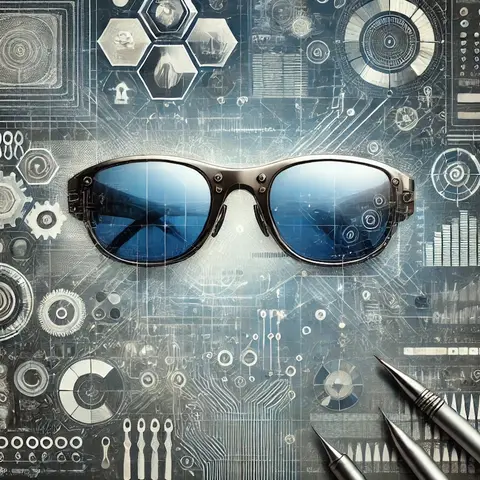
Seeing our Blind Spots: Smart Glasses-based Simulation to Increase Design Students’ Awareness of Visual Impairment
As the population ages, many will acquire visual impairments. To improve design for these users, it is essential to build awareness of their perspective during everyday routines, especially for design students.
Although several visual impairment simulation toolkits exist in both academia and as commercial products, analog, and static visual impairment simulation tools do not simulate effects concerning the user’s eye movements. Meanwhile, VR and video see-through-based AR simulation methods are constrained by smaller fields of view when compared with the natural human visual field and also suffer from vergence-accommodation conflict (VAC) which correlates with visual fatigue, headache, and dizziness.
In this paper, we enable an on-the-go, VAC-free, visually impaired experience by leveraging our optical see-through glasses. The FOV of our glasses is approximately 160 degrees for horizontal and 140 degrees for vertical, and participants can experience both losses of central vision and loss of peripheral vision at different severities. Our evaluation (n =14) indicates that the glasses can significantly and effectively reduce visual acuity and visual field without causing typical motion sickness symptoms such as headaches and or visual fatigue. Questionnaires and qualitative feedback also showed how the glasses helped to increase participants’ awareness of visual impairment.
https://dl.acm.org/doi/10.1145/3526113.3545687
Transcript 1,317 words
Ever find yourself wondering what it would be like to see the world differently? I mean, like, really differently. It's something most of us take for granted. Totally. But for a lot of people, vision loss is a daily reality. That's right. And it's only becoming more common as the population ages. Makes sense. And it makes accessibility even more important. Which brings us to today's Deep Dive.
We're talking about some seriously cool technology that could change how we think about accessibility. We're going to dive into these new smart glasses that can simulate visual impairments. And trust me, these aren't anything like those clunky goggles you might be picturing. Oh, good. Because those things were awful. Like trying to see through a pinhole and a piece of cardboard. Exactly. This is light years ahead of that.
We're talking LCD lenses. Kind of like those old 3D glasses, but way more advanced. Okay. So these lenses are actually changing what you're seeing. Yep. They're connected to an eye tracker and a microcontroller, which work together to adjust the image in real time. So as my eyes move around, the glasses are changing what I'm seeing. That's wild. You got it. When the eye tracker detects your gaze, it tells those lenses to adjust how much light they let through.
Whoa. So it's like experiencing those impairments firsthand, but obviously without any permanent effects. Precisely. And this real-world experience is what gives this tech a real edge over older simulation methods. You get a much wider and more natural field of view than you would with something like a VR headset. Oh, yeah. For sure. I've tried those VR headsets a few times, and they always leave me feeling kind of weird.
Like my brain can't quite process what my eyes are seeing. You're describing what we call vergence-accommodation conflict. Basically, it means your eyes are trying to focus on something far away, or your brain knows you're in a confined space. Uh-huh. So I'm guessing these smart glasses don't cause that problem. Nope. Because they have that more natural field of view, they eliminate that conflict.
You can wear them way longer without getting eye strain or headaches. Which I imagine really lets you get immersed in the experience. Exactly. And that's key, because a more realistic simulation has a much bigger impact. I bet. Reading about visual impairments is one thing, but to actually experience them even briefly, that's got to be powerful. Absolutely. And that's what makes this tech so groundbreaking.
It's not just about the technical side of vision loss. It's about fostering genuine empathy. So how did they test these glasses out? Like, what did they actually have people do? So they had design students wear these glasses while they did everyday tasks. Design students. Makes sense. They're the ones who will be creating the products and environments of the future. Exactly. Get them thinking about accessibility right from the start.
And for this study, one of the tasks was finding a hidden phone in a room. Okay. Sounds pretty straightforward. Right. But they had to do it twice. First with their normal vision, and then again wearing the glasses with different simulated impairments. I bet that second round was a lot trickier. You bet it was. And the results were fascinating. Just like you'd expect, the glasses made a huge difference in how well they could see.
So they actually confirmed that the glasses worked the way they were supposed to. They did. They were able to measure how much the glasses reduced visual acuity and peripheral vision. It really replicated the experience in a measurable way. That's incredible. But I'm even more interested in how it affected the participants on a personal level. Yeah, that's where it gets really interesting. People reported a much deeper understanding of what it's like to live with a visual impairment.
It must have been eye-opening for them to actually experience those challenges, even for a short time. Did the researchers share any specific stories? They did. Yeah. One participant talked about how different it felt to navigate a familiar room with the glasses on. Even simple things became a lot more challenging. It really makes you realize how much we take our vision for granted.
Absolutely. And that's why the researchers think these glasses could be revolutionary for inclusive design. Instead of just imagining what it's like, designers could actually experience those challenges firsthand. Exactly. And that could lead to products and environments that are truly accessible to everyone. By incorporating these experiences into the design process from the very beginning. It's a whole new way of thinking about accessibility.
It's not just about designing asterisk for asterisk people with disabilities, but designing asterisk with asterisk them. You got it. Yeah. And that kind of collaboration has the potential to lead to some amazing innovations. Imagine a world where accessibility is just a given in everything we create. Okay, now I'm getting excited about the future. But this tech, it's not as limited to design, is it?
I mean, it seems like this could be huge for feels like healthcare or education, too. Right. Absolutely. Think about it. Medical students could use these glasses to understand what it's like to have a visual impairment. It could make them more empathetic, better prepared to treat those patients. Oh, wow. Yeah. And architects could design buildings and spaces that are truly accessible to everyone, regardless of their vision.
Exactly. Creating a world where accessibility is built into the very fabric of our lives. That's the goal. That's amazing. And this is just the start, right? The researchers mentioned that this tech could be adapted to simulate other disabilities, too. That's right. We've been focused on vision, but imagine experiencing the world from the perspective of someone with hearing loss or mobility challenges. Wow.
It could revolutionize how we approach design in those areas, too. Absolutely. Yeah. It's all about challenging our assumptions and broadening our understanding of the human experience. This deep dive has definitely given me a lot to think about. But before we wrap up, I have to ask, are there any downsides to this technology? Nothing's perfect, right? That's true. There are a few limitations.
For one thing, even though these glasses have a wider field of view than VR headsets, they still can't capture everything a person sees, especially in the far periphery. So there are still some blind spots. You could say that. Mm-hmm. And then there's the weight. They're lighter than VR headsets, for sure. But they're still heavier than regular eyeglasses. So that could be a factor if you're wearing them for a long time.
Yeah. Comfort is important if you want people to really engage with the experience. What else? Well, this is getting a bit technical, but the refresh rate of the LCD lenses and the sampling rate of the eye tracker aren't quite as fast as our natural eye movements. So there's a slight delay when you move your eyes. Exactly. There's a tiny lag. Maybe 100 milliseconds.
Most people probably wouldn't even notice it. But it's something to keep in mind as the technology continues to improve. Makes sense. There's always room to grow. But it sounds like the potential benefits of these smart glasses really outweigh any limitations. I'd say so. So it's pretty exciting to think about how this tech could impact so many different fields, not just design, but also healthcare education and beyond.
It reminds us that sometimes all it takes is a new perspective to change the world. So true. Well, on that note, we'll leave you with this thought. If you could experience the world through someone else's eyes, whose perspective would you choose and why? Thanks for joining us for another deep dive. We'll see you next time.