Honorable Mention: Can a Smartwatch Move Your Fingers? Compact and Practical Electrical Muscle Stimulation in a Smartwatch
Akifumi Takahashi, Yudai Tanaka, Archit Tamhane, Alan Shen, Shan-Yuan Teng, and Pedro Lopes. 2024. Can a Smartwatch Move Your Fingers? Compact and Practical Electrical Muscle Stimulation in a Smartwatch. In Proceedings of the 37th Annual ACM Symposium on User Interface Software and Technology (UIST '24). Association for Computing Machinery, New York, NY, USA, Article 2, 1–15. https://doi.org/10.1145/3654777.3676373
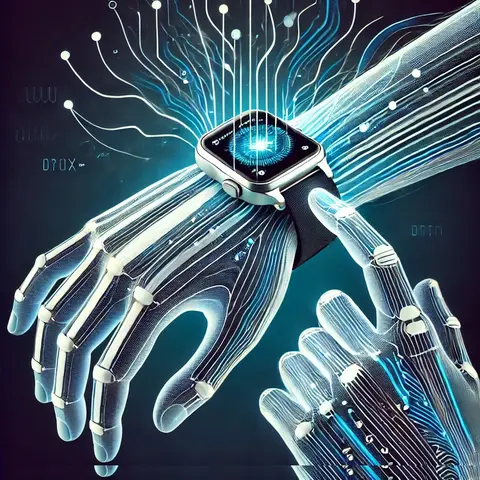
Smartwatches gained popularity in the mainstream, making them into today’s de-facto wearables. Despite advancements in sensing, haptics on smartwatches is still restricted to tactile feedback (e.g., vibration). Most smartwatch-sized actuators cannot render strong force-feedback. Simultaneously, electrical muscle stimulation (EMS) promises compact force-feedback but, to actuate fingers requires users to wear many electrodes on their forearms. While forearm electrodes provide good accuracy, they detract EMS from being a practical force-feedback interface. To address this, we propose moving the electrodes to the wrist—conveniently packing them in the backside of a smartwatch. In our first study, we found that by cross-sectionally stimulating the wrist in 1,728 trials, we can actuate thumb extension, index extension & flexion, middle flexion, pinky flexion, and wrist flexion. Following, we engineered a compact EMS that integrates directly into a smartwatch’s wristband (with a custom stimulator, electrodes, demultiplexers, and communication). In our second study, we found that participants could calibrate our device by themselves <Formula format="inline"><TexMath><?TeX $\sim 50 \%$?></TexMath><AltText>Math 1</AltText><File name="uist24-51-inline1" type="svg"/></Formula> faster than with conventional EMS. Furthermore, all participants preferred the experience of this device, especially for its social acceptability & practicality. We believe that our approach opens new applications for smartwatch-based interactions, such as haptic assistance during everyday tasks.
Transcript 1,950 words
Imagine receiving directions, not through sound, not sight, but through subtle sensations on your fingertips, all from your smartwatch. This potential future is what we will be examining today. We're taking a deep dive into the recent research presented at UAS 24. Can a smartwatch move your fingers? Compact and practical electrical muscle stimulation in a smartwatch. This research is compelling. It takes electrical muscle stimulation, a technology often perceived as bulky and cumbersome.
And presents a discrete and user-friendly implementation. The researchers address a significant limitation of traditional EMS. The use of electrodes placed on the forearm, a method that poses challenges for daily use. Indeed, the study highlights the cumbersome calibration process and the social awkwardness associated with visible electrodes, hindering the technology's widespread adoption. This is where the ingenuity of their approach becomes clear. They relocate all electrodes to the wrist, integrating them into a smartwatch band.
This is a strategic decision. While many finger muscles originate in the forearm, several essential ones are accessible at the wrist, an anatomical feature the researchers utilize. And they've gone a step further, developing a cross-sectional stimulation method, which involves placing electrodes on opposite sides of the wrist. This placement creates a deeper, more effective path for the electrical current, ensuring it reaches the intended muscles with greater precision.
Think of it as optimizing the delivery of electrical stimulation, much as one might arrange speakers to create a surround sound experience. To clarify, did the researchers investigate which electropositions corresponded to specific finger movements? They conducted a comprehensive study. It involved testing a significant number of hand poses and wristband positions, ultimately mapping muscle activation with great accuracy. And they achieved notable outcomes. They were able to generate reliable thumb extension, index finger extension, and flexion.
Middle finger flexion, pinky finger flexion, and even wrist flexion. And all of this by stimulating muscles from the wrist. Yes, this finding is significant. Because it demonstrates that their innovative approach can produce a range of finger movements, previously thought to require direct forearm stimulation. This naturally leads to the question of real-world practicality. Was this aspect addressed in their research? To address this, they designed a second study, specifically to assess the practicality and social acceptance of the wrist-based EMS system.
Two crucial factors for any new technology's success. And did they involve users in this study? To ensure realism, the researchers tasked participants with calibrating the wrist-based EMS device without assistance. This approach aimed to evaluate the system's intuitiveness for first-time users. That's quite a challenge. To familiarize users with a novel interface without guidance. How did the participants manage? They performed surprisingly well. Participants calibrated the wrist-based EMS device 50% faster than a traditional forearm-based system.
This result underscores the practical advantage of this new design. That's a substantial difference, indicating that it's not just about discretion, but also enhanced user-friendliness. What about social acceptance? Were participants at ease wearing the device in public? This is where the study becomes even more compelling. Participants were asked to wear the device in public settings, interacting with others as they typically would. So, they essentially went about their day, gauging reactions to the device.
Did they have someone in the field to observe reactions? Yes. They employed a confederate to engage participants in conversation, observing if they exhibited any self-consciousness about wearing the device. So, while they weren't tasked with any extraordinary feats, this aspect of the study was crucial for understanding how the technology might be perceived in everyday situations. What were the reactions? The study revealed that participants were entirely comfortable wearing the device during their public outings.
They reported that it went largely unnoticed. So, a slightly thicker smartwatch didn't seem to draw any undue attention. Did they offer any comparisons with their perception of wearing the traditional forearm EMS setup? Several participants expressed concerns about the potential awkwardness and stigma associated with visible electrodes on their forearms. They imagined it would draw unwanted attention and make social interaction uncomfortable. Understandably. It highlights the importance of a technology being both functional and socially acceptable for it to be truly integrated into our lives.
Precisely. The desire to experience cutting-edge technology shouldn't come at the cost of personal comfort. This research demonstrates that both are attainable. We now have this compact device, capable of controlling finger movements, discreetly placed on the wrist. The next question is what can it do? What are the potential applications that have garnered so much excitement? That's where things become exceptionally promising. The applications of this technology extend far beyond what one might initially envision.
From what we've discussed so far, this technology has implications that go beyond simple haptic notifications. It seems to represent a completely new way to interact with technology and our surroundings. Indeed, the researchers have outlined several potential applications, with haptic guidance during exercise being one notable example. So, rather than looking at a smartwatch for guidance, users would feel it. That would be a significant development for those who value focus during workouts.
Imagine a scenario where you feel a slight pull on your thumb, reminding you to maintain proper posture during squats. Or perhaps a gentle flexion of your index finger signals the beginning of your next set. It would be as if you had a personal trainer on your wrist, guiding your every movement, eliminating the need to glance at screens mid-workout. Precisely. The researchers also explored the potential for eyes-free GPS navigation using this technology.
That's a use case many can relate to. Navigating an unfamiliar city while trying to discreetly check your phone can be a challenge. It does highlight the limitations of current navigation systems. Now, imagine walking down the street, guided by subtle finger movements from your smartwatch. A tug to the left for an upcoming left turn. A flex to the right for a right turn.
This would eliminate the need to constantly consult your phone screen. That would be transformative. Yeah. Especially for those who struggle with navigation. What about reaching your destination? Would there be a specific indication? They've addressed that as well. Their proposed solution involves a thumbs-up gesture, triggered by the wrist-based EMS to signal arrival. A fitting way to conclude your journey. It appears this technology could also revitalize existing EMS applications.
Earlier, you mentioned drumming. Can you elaborate on that? Certainly. One example they provided involved using wrist-based EMS to offer haptic feedback during drumming practice. Imagine feeling the rhythm on your wrist, guiding your movements as you master new beats or complex rhythms. So it's not just about hearing the music, but feeling it as well. Precisely. And because the device is so compact and unobtrusive, it wouldn't hinder movement.
It's all about enhancing the experience, not detracting from it. That's a crucial point. What about applications in immersive experiences? EMS has been explored in virtual reality, hasn't it? It has, and this research builds upon that concept. They envision a future where smartwatches with integrated EMS serve as force feedback devices for VR games. Imagine feeling the resistance of turning a virtual steering wheel, all through subtle muscle stimulation on your wrist.
It adds a whole new dimension of realism to gaming. And because the EMS is integrated into a smartwatch, it eliminates the need for bulky peripherals. Users can simply put on their smartwatch and immerse themselves in the experience. It suggests a future where technology seamlessly blends with our lives, augmenting our capabilities and perceptions in ways we're only beginning to explore. This research exemplifies that shift towards a more immersive and intuitive technological landscape.
And it goes beyond just creating new experiences. It's also about improving existing ones. They even revisited a previous research project that focused on smart objects, specifically using EMS to create them. You're referring to the smart door application, I presume. It's an example of how wrist-based EMS could enable more discreet and socially acceptable interactions. Yes, the initial version of this smart door relied on forearm EMS to communicate with users, which could be awkward in certain settings.
Imagine approaching a door. Instead of a knock or a flashing light, feeling a subtle pulse on your wrist, indicating whether the occupant is available. It represents a more subtle and context-aware way to interact with our surroundings. It appears this technology has the potential to transform how we interact not only with our devices, but also with everyday objects. Potentially ushering in a world where technology seamlessly integrates into our lives without being intrusive.
That is the ultimate goal, is it not? To create technologies that are both powerful and unobtrusive. Enhancing our lives without dictating them. This research represents a significant step in that direction. While this wrist-based EMS technology appears to hold great promise, are there any limitations or challenges the researchers acknowledged in their work? There are. While their studies demonstrate the feasibility and practicality of wrist-based EMS for various applications, they acknowledge there is room for improvement.
Currently, the system cannot actuate all five fingers independently. Movements requiring fine motor control remain beyond its capabilities. That's understandable. Our hands are remarkably complex. Replicating their full range of motion with external stimulation is a considerable challenge. Indeed. However, it's crucial to remember that this is just the beginning. Researchers are already exploring ways to enhance the dexterity of the wrist-based EMS system. One promising avenue is incorporating automatic calibration techniques.
So, rather than requiring users to calibrate the device, it would adjust itself based on individual anatomy and muscle responses. That would be quite convenient. Imagine a wristband that simply works upon being worn, automatically adjusting its stimulation parameters to provide the most accurate and comfortable experience. That's the level of seamless integration they aim to achieve. Automatic calibration would certainly enhance practicality. You mentioned the integration of other sensing technologies.
Could you elaborate on that? One area of exploration involves integrating the wrist-based EMS with real-time pose detection. Meaning the device wouldn't just stimulate muscle movements, but also detect the hands' position and orientation. That suggests a sophisticated feedback loop. Precisely. By combining these technologies, they could create a system that adapts to hand movements instantaneously, resulting in even more precise and nuanced haptic feedback.
This opens up some remarkable possibilities. Imagine a world where we control our digital devices with subtle hand gestures, all while receiving tactile responses through our wrists. It could revolutionize our interactions with technology. It does present a future brimming with potential. Imagine a surgeon receiving haptic feedback during a complex robotic surgery, or a musician sensing the subtleties of a virtual instrument through their fingertips, all thanks to this technology.
It's not just about replacing current interfaces, but creating new ones, pushing the boundaries of human-computer interaction. This research has certainly opened the door to such a future. By reimagining a technology often viewed as cumbersome and impractical, they've established a foundation for innovation that could transform how we interact with the world around us. While still in its early stages, the implications of this technology are vast.
It leaves us with much to consider. As we move towards a future where technology is increasingly intertwined with our physical selves and senses. This research serves as a potent reminder that the most transformative innovations often stem from challenging assumptions and exploring the unknown. This has been a fascinating exploration of a potentially groundbreaking technology. For our listeners, we encourage you to consider the possibilities of a world where we can quite literally feel the digital realm.
A world brought closer by the innovative research we've discussed today. This concludes our deep dive for today. Until next time.