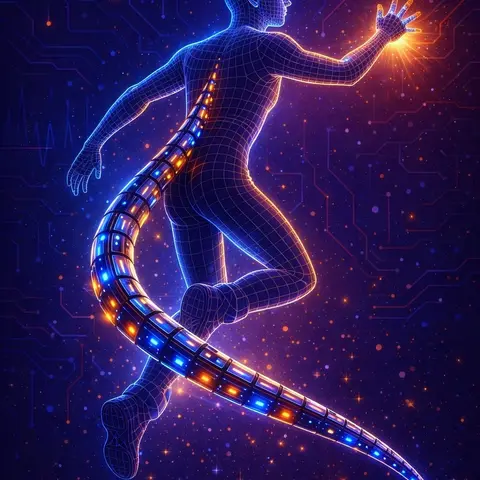
Imaginary Joint: Proprioceptive Feedback for Virtual Body Extensions via Skin Stretch
Virtual body extensions like wings or tails offer exciting new experiences in VR, but using them naturally—especially parts you can't see, like a tail—requires proprioceptive feedback to sense position and force without relying on vision. This paper introduces the "Imaginary Joint," a novel approach that uses skin-stretch feedback at the interface between your body and a virtual extension. A wearable device stretches and compresses skin on both sides of the waist to convey joint angle and torque from a virtual tail. The system simultaneously communicates both rotation and force by superimposing skin deformations. In controlled experiments, skin-stretch feedback significantly outperformed vibrotactile feedback in perceptual accuracy, sense of embodiment, and naturalness—with participants reporting the sensation felt remarkably like having an actual tail.
Shuto Takashita, Jürgen Steimle, and Masahiko Inami. 2025. Imaginary Joint: Proprioceptive Feedback for Virtual Body Extensions via Skin Stretch. In The 38th Annual ACM Symposium on User Interface Software and Technology (UIST '25), September 28–October 01, 2025, Busan, Republic of Korea. ACM, New York, NY, USA, 15 pages. https://doi.org/10.1145/3746059.3747800
Transcript 2,351 words
Welcome to the Deep Dive. Today we are taking a deep exploration into the fusion of the human body and technology. We're focusing on a specific challenge. How do you integrate a virtual extension, say an extra arm or even a tail, into your physical self? And that challenge is at its core a profound physiological dilemma. When you augment the body with something that has no innate sensory nerves,
how does the user know where it is? Right. How do you feel its position, the forces it encounters, without having to look at it all the time? Exactly. We're talking about a lack of proprioceptive feedback, that sort of sixth sense that tells your brain where your limbs are in space. And the sources we've looked at propose a novel solution to this gap, something called the imaginary
joint. It uses localized skin stretch feedback right at the boundary between your body and this virtual extension. It's a captivating idea. It is. So our mission for you today is to unpack the mechanism of this technology, review how it was tested, and grasp the implications of successfully constructing a fictional sensation that your brain might just accept as its own. Hmm. Okay. So let's set the stage
with these body augmentation technologies. They're moving out of science fiction. You know, we're seeing designs for supernumerary limbs, extra fingers, even robotic tails. Correct. And their applications are twofold. On one hand, they enhance operational efficiency. Think of a surgeon who could use a third arm. But just as important, they expand our expressive capabilities. In what way? Well, in virtual environments, these extensions can be used to convey very subtle social cues, emotions, things that are otherwise hard
to communicate without seeing a person's face. So what's the primary barrier holding these innovations back? You mentioned that fundamental biological limitation. It's the lack of a neural connection. Without that, the user has to depend almost entirely on visual cues. And what's the cost of that visual dependence? It creates a severe cognitive burden. If you have an extension, say a robotic tail or an arm
mounted on your back, it's often outside your field of view. You can't just keep looking over your shoulder. You can't. It's impractical, sometimes impossible. So your efficiency drops because you're diverting mental resources just to track the limb. And in a social VR setting, this leads to unintended collisions. You just don't feel the boundary of your augmented self. So if sight is inefficient, why is this skin
stretch method seen as a better approach than other non-visual techniques? We already have things such as vibration or electrical stimulation. That is the core insight of this deep dive. Conventional methods, vibration for instance, they typically convey abstract data coordinates for where the limb is. And electrical methods often need to target residual nerves, which is irrelevant for a body part that never existed in the first place. Skin stretch is fundamentally different. It mimics the
natural input the brain already understands from proprioception. When a muscle contracts or a tendon pulls, the skin around that joint stretches and compresses. Our brain has evolved to interpret that sheer force as movement and tension. So it's tapping into an existing system. Precisely. Previous work has even shown that skin stimulation near the elbow could evoke a sensation that users described as an imaginary
pendant. We are essentially leveraging the brain's existing framework for body awareness. Let's transition from that physiological metaphor to the engineering. How did they actually build the hardware to create this physiological illusion, this imaginary joint? The physical device is a specialized wearable. It's quite light weighing, 83 grams per unit, and it's designed to be mounted around the waist. And for this study, it was simulating what kind of motion? A single degree of freedom or one DOF lateral motion.
So just side-to-side sway or side-to-side force. Only one DOF for now. Got it. So walk us through the mechanics. How does it generate that precise skin stretch? The hardware is engineered specifically for robust shear force. It uses a rod-shaped actuator that runs parallel to the skin. This is driven by a rack and pinion mechanism. And there are two of them. Yes. Two identical units are placed on the back of the waist,
one on each side of where the virtual joint would be. This is what creates the asymmetric forces needed to simulate movement. I saw a specific detail in the sources about the mounting. The use of six-millimeter thick high-friction neoprene foam. Why was that detail so essential? That's a critical engineering constraint. To get robust and consistent deformation of the skin, the actual stretching, the device has to
be firmly coupled to the body. That foam provides the high-friction interface needed. And it also mentioned a substantial amount of pressure. It did. The mounting must apply a normal force between 30 and 50 newtons perpendicular to the skin. 50 newtons sounds quite forceful for a wearable. It is, but it's required to prevent slippage. If the device slips relative to the skin, that shear force, the whole
illusion of muscle tension, is lost. That pressure guarantees that when the actuator moves, the skin deforms with it. So the central metaphor is executed through this literal manipulation. If the virtual tail curves left, the skin on one side is compressed and the other side stretches. You're building a sensation from scratch. And once the hardware was validated, the researchers faced the next major hurdle,
creating what they call informing mappings. Meaning they had to figure out how to translate the virtual information into a physical sensation. Exactly. They had to solve the inverse problem. How do you convert two independent virtual parameters, the tail's rotational angle and its torque, into one coordinated set of actuator movements that the brain can intuitively decode. Two distinct variables through one tactile channel. So how did they assign the sensation for each? Let's start with rotation. For rotation or angle,
which was condition one, they decided the two actuators would move synchronously. So when the tail tilted to the right, the skin on the left side of the waist was extended. And how did that feel to participants? This was strongly preferred. People consistently reported that the feedback felt as though the tail moved smoothly. They found it highly intuitive for sensing position. Okay, so what about torque or force? That's a measure of
resistance, not position. So the mapping must be quite different. It is. For torque condition two, the goal was to communicate strain. In this case, the skin on the side experiencing the force was greatly extended. What was the metaphor there? The metaphor was of a muscle and tendon being stretched against an external load while trying to contract. This mapping was also highly favored with people reporting a strong sense of directionality and often
comparing it to a physical muscle stretching. And this is where it becomes quite captivating. They then had to test the dual estimation task, which is perceiving both angle and torque at the same time. How did they combine those two distinct sensations? Through superposition. The final actuator stimulus, which they termed PI text, was derived by taking the arithmetic mean of the rotation stimulus and the torque stimulus. Can you help us picture that for the listener?
If the tail is tilted 45 degrees right, but it's hitting high resistance, how does that feel different from tilting 45 degrees in free air? That's the clever part. In free air, the sensation is balanced to primarily convey the 45 degree angle. But if it hits high resistance on the right, the torque mapping kicks in, significantly increasing the stretch on the left side of the body, the side pulling against that resistance. Ah, so the average of the two
signals changes the overall feeling. Correct. The combined stimulus skews the sensation toward that high torque feeling, subtly communicating both position and resistance through the magnitude and symmetry of the stretch. It's an efficient way to relay multidimensional data. Now for the experimental results, the main study put this skin stretch feedback up against a conventional baseline, a vibro-tactile condition. What did the raw accuracy data show? Well, the performance data on perceptual accuracy was a clear validation for the imaginary
joint. Skin stretch feedback decisively outperformed vibro-tactile feedback across all three estimation tasks. All three. So rotation, torque, and the combined tasks. Can we put that performance difference into more tangible terms? What did that accuracy look like? We can quantify it. For instance, in the rotation estimation task, the skin stretch approach yielded an error of about 0.60 error steps. That translates to a spatial error
of just 10.8 degrees. 10.8 degrees. That's quite precise. It is. It was notably superior to the 0.82 error steps they saw in the vibro-tactile condition. And to give you some context, 10.8 degrees is less than the width of your thumb held out at arm's length. That's precise enough to navigate a crowded virtual room without constantly glancing back at your tail. Precisely. Now, there was one limitation we should
note. The estimation clarity did decrease when the angle and torque stimuli were combined. So it was harder to separate the two. A bit, yes. Participants did experience some cognitive load trying to separate the two variables from that one superimposed sensation. But the results confirmed they could still perceive them as partially separable dimensions. That's the quantitative side. What about the subjective experience? How did it feel? That's where the results are even more compelling. Skin stretch scored
significantly higher than vibration across all categories. Ownership, agency, enjoyment, naturalness, and intuitiveness. The brain just accepted the fictional muscle sensation far more readily than the abstract buzzing. And the qualitative feedback seems to seal the case. Participants described the sensation as resembling an innate body feeling. They used phrases such as felt tail-like. One person noted that it closely resembled what I imagine it would feel like if I had a tail that could move laterally.
That superior naturalness is key to successful embodiment. There was also a note about VR sickness. Yes, a fascinating side effect. Two participants reported VR sickness, but only during the vibro-tactile condition. It suggests the brain's rejection of that unnatural sensory input the vibration might contribute to simulator sickness. So the skin stretch approach could offer greater comfort for prolonged use. Okay, let's turn to the practical applications this enables. The first, and maybe most immediate,
is simply refining the perception of extended bodies in virtual spaces. Yes. If users have precise non-visual awareness of their posture, it eliminates significant problems in social VR. It helps avoid those unintended collisions or tails obstructing someone's view. It just improves general spatial awareness. And frees up cognitive resources for other tasks. Exactly. Secondly, I'm thinking about enhanced bodily expression. In performance contexts, such as dance or theater, this could be transformative. It could. If a
dancer uses a robotic tail to signal an emotion, this proprio-sective feedback ensures they don't have to break character to visually check the tail's position. It elevates the expressive quality. A third critical area is body-mediated communication. What does that mean exactly? Well, imagine a scenario where the extension's movement is controlled externally by another user, maybe, or by an AI. The user isn't commanding the movement themselves. So they lack that motor command,
the efferent cue. Correct. The brain isn't sending the output signal. In that case, providing the strong afferent feedback, the input confirming the movement from the imaginary joint is crucial for making sense of it. It lets you feel what's being done to your body. Precisely. It facilitates better attentional allocation and reduces the cognitive load of integrating that external movement. Despite this success, what are the clear limitations of the current system? Where does the research go from here?
The most obvious limitation is that it's currently only one D off, just lateral motion. The logical next step is extending this to a 2-do-f configuration, so adding yaw and pitch, or even tackling multi-joint structures. Which would dramatically increase the complexity of the mappings. Without a doubt. Another area for refinement is the mapping itself. The actuator movement is currently linear, but human perception
is non-linear. So a smart push might feel like a lot, but a big push doesn't feel proportionally bigger. Something along those lines. Adjusting the mapping to account for that could minimize the perceptual errors. Particularly in that middle range where the dual inputs cause some confusion. And the final hurdle seems to be a practical one. Making this something you can actually wear day to day.
Indeed. The requirement for wearing the device directly on bare skin is a significant hurdle for adoption. Future work has to focus on developing sheer feedback methods that remain clear and discriminable even through clothing. In synthesis, the imaginary joint system marks a significant milestone. It's a fundamental shift in the design paradigm. It's not about generating abstract signals. It's about designing body-like feedback for parts that do not naturally exist. It's leveraging that localized skin stretch to simulate the
tension of a fictional joint. And by doing that, the system achieves superior embodiment, naturalness, and perceptual accuracy compared to conventional modalities for conveying both position and force. So if we can successfully engineer a fictional sensation, a sense of muscle and tendon that the brain fully accepts and integrates as innate, how far can we actually push the boundaries of body schema modification? That is the ultimate question.
This technology suggests that the definition of the physical self is more malleable than we might have assumed. If self-awareness can be expanded by touch alone, we are not simply adding tools. We are expanding the very definition of what it means to be human in these augmented environments. That concludes this deep dive into the integration of virtual extensions and the quest for innate
proprioceptive feedback. Thank you for joining us.